Friday, October 20, 2006

LETTER: Re. Max Boot's training Iraqi troops excuse

To: Los Angeles Times

Max Boot's Oct. 18 column "Bring Iraqi Forces Up to Speed," implies Iraqis are apes who just descended from the trees, and can't figure out how to put a military and police force together. Somehow, the insurgents aren't having a problem attacking our troops, and a decade before we invaded, Iraq fought a Iran, a much larger country to a draw. The problem is not training, but motivation.

The current problem is getting troops and cops to fire on their own people who they know may have a legitimate beef with us being there. Which sounds a hell of a lot like Vietnam. Wasn't that the big plan there? Train the Vietnamese to fight for us in our absence? Altough it was never put that bluntly, that's the real problem.

When the perception and reality are we are there to screw them out of their oil wealth and kill those who protest too much with either airstrikes or death squads, it's going to be tough to find people to consistently fight for us. Those who do are unlikely to be choir boys, and will likely inspire even less love for the puppet government.

Maybe if pissants like Max Boot spent less time making up fake macho names for themselves or more time reading history, talking to Iraqis, or God forbid, actually serving in the military themselves, they wouldn't say things that get thousands of our troops and over half a million Iraqis killed.


public relations

Tuesday, October 17, 2006

ALTERNET: Bush's Petro-Cronies almost lock in control of Iraq's OIL

This is the most aggravatingly ignored story of the Iraq War,and the real reason why we are there. Bush hase given his oil cronies a gift worth up to $20 TRillion right now, that will probably be worth a lot more by the time the last barrel is pumped, and doesn't include large undiscovered reserves that they think are out there.

Beneath the obvious lies about WMD, terrorism, and spreading democracy, a second layer of argument for the war is that strategically, we needed control of that oil for our economy.

We didn't.

We could have simply bought it the way China and others are doing. If Saddam or anyone else stopped selling to us, they'd be shooting themselves in the foot since we use 25% of the world's supply. That would be like a drug dealer cutting off Robert Downey Jr.

Second, if we needed control of that amount of energy, the half trillion we have already spent in Iraq could have built enough solar panels and wind turbines to power new cars with electricity, and could have provided subsidies for ethanol and biodiesel until those electrics are on the road.

No, this war was simply about which companies profited from pumping the oil, and whether it bought a yacht in Shaghai or Houston.

The Iraqis and the rest of the world know this story. Most Americans and even progressives seem to be oblivious to it, but if this is why we are there, it stands to reason that we won't be able to pull out of Iraq until we figure out how to separate those oil companies from Iraq's oil teat, or at least a way to make their deals something the average Iraqis doesn't think is a scam.

Ironically, while people in Iraq and Venezuela vote and march in the streets on this issue, most Americans don't know how much we get for oil taken on public lands or even that we get or should get anything for that.

KEY EXCERPTS:


Bush's Petro-Cartel Almost Has Iraq's Oil


By Joshua Holland, AlterNet. Posted October 16, 2006.


During the 12-year sanction period, the Big Four were forced to sit on the sidelines while the government of Saddam Hussein cut deals with the Chinese, French, Russians and others
(despite the sanctions, the United States ultimately received 37 percent of Iraq's oil during that period, according to the independent committee that investigated the oil-for-food program, but almost all of it arrived through foreign firms). In a 1999 speech, Dick Cheney, then CEO of the oil services company Halliburton, told a London audience that the Middle East was where the West would find the additional 50 million barrels of oil per day that he predicted it would need by 2010, but, he lamented, "while even though companies are anxious for greater access there, progress continues to be slow."

Chafing at the idea that the Chinese and Russians might end up with what is arguably the world's greatest energy prize, industry leaders lobbied hard for regime change throughout the 1990s. With the election of George W. Bush and Dick Cheney in 2000 -- the first time in U.S. history that two veterans of the oil industry had ever occupied the nation's top two jobs -- they would finally get the "greater access" to the region's oil wealth, which they had long lusted after.


If the U.S. invasion of Iraq had occurred during the colonial era a hundred years earlier, the oil giants, backed by U.S. forces, would have simply seized Iraq's oil fields. Much has changed since then in terms of international custom and law (when then-Deputy Secretary of Defense Paul Wolfowitz did in fact suggest seizing Iraq's Southern oil fields in 2002, Colin Powell dismissed the idea as "lunacy").


But the execs from Big Oil didn't just want access to Iraq's oil; they wanted access on terms that would be inconceivable unless negotiated at the barrel of a gun.
Specifically, they wanted an Iraqi government that would enter into production service agreements (PSAs) for the extraction of Iraq's oil.

PSAs, developed in the 1960s, are a tool of today's kinder, gentler neocolonialism; they allow countries to retain technical ownership over energy reserves but, in actuality, lock in multinationals' control and extremely high profit margins -- up to 13 times oil companies' minimum target, according to an analysis by the British-based oil watchdog Platform.

FULL TEXT:

http://www.alternet.org/waroniraq/43045

PART II

http://www.alternet.org/waroniraq/43077


IRAQ OIL LINKS:

(covers nearly all sources mentioned in article)
http://professorsmartass.blogspot.com/2006/09/iraq-oil-...


public relations

Friday, October 13, 2006

Why did Bush invade Iraq? $6-20 TRILLION minimum for oil companies

Take the current price of oil, about $60 per barrel, and assume that won't change much (the general trend will be up though) and multiply that by the range of estimates of unpumped oil in Iraq. The Brookings Institute says the DOE lowballs it at 112 billion barrels but some estimates are as high as 300 bbl.

112 billion x $60 = $6.7 trillion

300 billion x $60 = $18 trillion


If you fool around with different pricing scenarios, it's not hard to imagine those numbers being a lot higher, particularly as other oil reserves run dry, the prices run up, and the Persian Gulf is the last place with easily recoverable oil.

Bush forced the Iraqis to denationalize their oil, cancelled Saddam's contracts with other countries, and gave them to American companies.

Everything else Bush has done has been about cronyism or suckering the religious right enough to vote for him so that he can practice cronyism.

Why is it so hard for the press, the Democrats, and even most in the "progressive" press to say out loud that Bush went there to steal oil and give it to his friends?

BEST LINKS ON IRAQ OIL STORY:

http://professorsmartass.blogspot.com/2006/09/iraq-oil-war-resources.html


Sunday, October 01, 2006

Update on the censored struggle for Iraq's OIL

I've got to do more research on this, but my opinion of Joe Biden has just gone up. Apparently, he tried to pass legislation that said the US should not exert "control over any oil resource of Iraq."

The GOP gutted the original bill and Biden tried to add it as an amendment to something else.

Given the virtual news blackout of the oil machinations in Iraq and in particular how American oil companies are profiting from it, Biden's action looks like a thankless (and in fact dangerous) act of principle rather than the glory dog opportunism and corporate toadying he often appears to be doing.

It never ceases to amaze me that we invaded the country with the world's second largest oil reserves, and not only do neither the administration and the mainstream media rarely discuss it, but neither does most of the progressive media, instead rehashing how the reasons given for going in were lies (WMD, terrorism) or buying into the reasons the administration gives for staying (democracy, stability, security) but claiming they aren't succeeding at those equally imaginary or at least secondary objectives.

A lot of people say it is enough to note that we wouldn't be in Iraq if it's main export was coconuts, but we publish and critique every bullshit pronouncement about the number two al qaeda man in Iraq, or new defense of the war that is simply a reworking of the same speech given since 2002.

The case for the war for oil is pretty well established and documented though not widely published.
(see oil links after article)


For those who see through the more embarrassing excuses for the war, there's a second level of lies that seems to assuage the consciences of people in the Pentagon and State Department: we need that oil for our economy. Colin Powell's lieutenant Larry Wilkerson said as much plainly.

But this argument is also a lie. If it was just about access to oil, we could get it the way China from Iran, Canada, and Venezuela: buy it on long-term contracts.

Instead, this is about who profits from pump Iraq's oil--Iraqis and foreign oil companies, or American oil companies (tipping the Iraqis whatever their generosity moves them to).

KEY EXCERPTS:


Oil Pressure


When it comes to oil, the U.S. administration is bypassing democracy in Iraq


Greg Muttitt | August 28, 2006

The U.S. campaign on the fledgling Iraqi government has been successful. Following his appointment in May, new Oil Minister Husayn al-Shahristani announced that one of his top priorities would be the writing of an oil law to allow Iraq to sign contracts with "the largest companies."

This would be the first time in more than thirty years that foreign companies would receive a major stake in Iraq's oil. Oil was brought into public ownership and control back in 1975.


Mr. Bodman did not stop at reviewing the draft law himself in Baghdad: he also arranged for Dr. Al-Shahristani to meet with nine major oil companies - including Shell, BP, ExxonMobil, ChevronTexaco and ConocoPhillips - for them to comment on the draft as well, during the Minister's trip to Washington DC the following week.

Given the pressures involved, perhaps the Minister felt he did not have much choice. His promise to pass the law through parliament by the end of 2006 was set in Iraq's agreement with the International Monetary Fund last December. According to that agreement, IMF officials would also review and comment on a draft in September. And still, the draft law has not been seen by the Iraqi parliament. Meanwhile, an official from the Oil Ministry has stated that Iraqi civil society and the general public will not be consulted at all.

The issues could hardly be more important for Iraq. Oil accounts for more than 90% of government revenue, and is the main driver of Iraq's economy. And decisions made in the coming months will not be reversible - once contracts are signed, they will have a major bearing on Iraq's economy and politics for decades to come. No wonder a recent poll showed that when asked what Iraqis thought were the three main reasons why the United States invaded Iraq, 76% gave "to control Iraqi oil" as their first choice.

Attempting to reverse this perception and change U.S. policy, lawmakers in the House and Senate have passed legislation stating that the United States should not exert "control over any oil resource of Iraq."
But usurping democracy here at home, Republicans stripped this language out of the bill's final version Hoping for better luck the second time around, Senator Joe Biden successfully led the charge to add this language to another bill currently awaiting final passage.


FULL TEXT:


http://fpif.org/fpiftxt/3466


Biden Iraq Oil Amendment:
S.AMDT.3717
Amends: H.R.4939

AMENDMENT PURPOSE:

To provide that none of the funds made available by title I of this Act may be made available to establish permanent military bases in Iraq or to exercise control over the oil infrastructure or oil resources of Iraq.
Author of this article's detailed report on restructuring of Iraq's oil industry to benefit our oil companies:
http://www.globalpolicy.org/security/oil/2...

Greg Palast's timeline of Iraq oil meetings (with video interviews with the players):

http://www.gregpalast.com/iraqmeetingstime...

Colin Powell's chief of staff on oil motive for Iraq War:

http://professorsmartass.blogspot.com/2005...

Broader background on oil, war, and foreign policy:

http://www.mymethow.com/~joereid/oil_coup....

Naomi Klein on privatization and its effects in Iraq:

http://www.harpers.org/BaghdadYearZero.htm...

Economic war crimes in Geneva and Hague Conventions:

The Hague Convention of 1907 (IV) see articles 47, 53, 55
http://www.icrc.org/ihl.nsf/FULL/195?OpenD...

The Geneva Convention of 1949 (IV) we've broken almost every section of article 147, and Bush has personally broken article 148.
http://www.icrc.org/ihl.nsf/FULL/380?OpenD...
The Bush Agenda: Invading the World, One Economy at a Time author's website:
http://www.bushagenda.net/index.php

A good brief summary of neoliberalism:
http://www.corpwatch.org/article.php?id=37...

How "economic hit men" set it up and enforce it:
http://www.johnperkins.org/Preface.htm


public relations

Saturday, September 30, 2006

Gore Vidal quote that parallels Goering on starting wars

Gore Vidal:
"Joseph Schumpeter ... in 1919, described ancient Rome in a way that sounds eerily like the United States in 2001: "There was no corner of the known world where some interest was not alleged to be in danger or under actual attack. If the interests were not Roman, they were those of Rome's allies; and if Rome had no allies, the allies would be invented . . . The fight was always invested with an aura of legality. Rome was always being attacked by evil-minded neighbours."' We have only outdone the Romans in turning metaphors such as the war on terrorism, or poverty, or Aids into actual wars on targets we appear, often, to pick at random in order to maintain turbulence in foreign lands."


http://www.tamilnation.org/intframe/iraq/v...

Hermann Goering:
"Why, of course, the people don't want war," Goering shrugged. "Why would some poor slob on a farm want to risk his life in a war when the best that he can get out of it is to come back to his farm in one piece. Naturally, the common people don't want war; neither in Russia nor in England nor in America, nor for that matter in Germany. That is understood. But, after all, it is the leaders of the country who determine the policy and it is always a simple matter to drag the people along, whether it is a democracy or a fascist dictatorship or a Parliament or a Communist dictatorship...voice or no voice, the people can always be brought to the bidding of the leaders. That is easy. All you have to do is tell them they are being attacked and denounce the pacifists for lack of patriotism and exposing the country to danger. It works the same way in any country."
When Hitler talked to his inner circle about his plans for war, his words could have come from the mouth of any world leader--but probably not publicly:

We were living in an age of economic empires in which the primitive urge to colonization was again manifesting itself; in the cases of Japan and Italy economic motives underlay the urge for expansion, and with Germany, too, economic need would supply the stimulus.

Adolf Hitler, Hossbach Memorandum
http://www.historyplace.com/worldwar2/time...

Dick Cheney had a similar thought:
Oil is unique in that it is so strategic in nature. We are not talking about soapflakes or leisurewear here. Energy is truly fundamental to the world’s economy. The Gulf War was a reflection of that reality.


Governments and the national oil companies are obviously controlling about ninety per cent of the assets. Oil remains fundamentally a government business. While many regions of the world offer great oil opportunities, the Middle East with two thirds of the world’s oil and the lowest cost, is still where the prize ultimately lies, even though companies are anxious for greater access there, progress continues to be slow...


Dick Cheney, 1999 speech to at the Institute of Petroleum

http://www.energybulletin.net/559.html

Luckily for the oil industry, Cheney figured out a time-tested shortcut around that "slow" progress.


< public relations

Tuesday, September 26, 2006

MUST READ ZOGBY POLL: only 45% of voters think Bush won election "fair and square"

Once again, another country uses an American polling firm to conduct a poll here whose results should be front page news here--and probably won't be on TV news or in any major news paper.

It is no surprise that 71% of blacks have serious doubts about Bush's victory given the voter roll purges, intimidation, withholding of voting equipment and vote suppression tactics that haven't done on this scale the Jim Crow era. But 54% of ASIANS don't think he won fairly either.

There are a couple of questions like this that make it hard to compare Bush to other presidents because few would wonder if other presidents cheated on a scale to change the outcome. I have no doubt that Ronald Reagan beat Walter Mondale in 1984, that Papa Bush beat Dukakis in 1988, and if Papa Bush had beat Clinton in 1992 instead of the other way around, I wouldn't have spent much time thinking about how that defied logic either because it didn't.

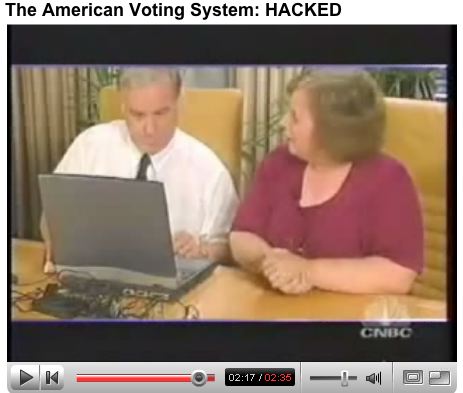
On the other hand, there were a couple of immediate red flags with Bush's re-election. He had the lowest approval rating of any re-elected president since Harry Truman, and the poll numbers I found for Truman were a couple of months before the election, so he might have pulled up. It was also the first time exit polls varied dramatically from the vote count and the variance that was outside of the margin of error all favored Bush. Most of this variance occurred in areas with electronic voting machines that are easily rigged and have no way to do a recount apart from looking at the number on the screen again. Every major university that has looked at the voting machines have easily found how to rig them in a matter of seconds, as Howard Dean was shown in this video:


The good news here is that the majority of Americans are figuring out what's going on despite a virtual blackout in the mainstream media.

This is one of the reasons the rest of the world does not take Bush's talk about trying to spread democracy seriously. In 2000, while we were watching old farts fumble with butterfly ballots election night, the rest of the world was watching blacks talk about being purged from the voter rolls and denied their right to vote on the BBC.

If this is how he treats his own citizens, how real will he let the democracy be in a country he invaded to give its resources to his friends?


KEY EXCERPTS:



ZOGBY POLL: VOTERS QUESTION OUTCOME OF 2004 PRESIDENTIAL ELECTION

Edited on Sun Sep-24-06 10:48 PM by autorank
Monday, 25 September 2006, 1:25 pm (NZ)

Only 45% of Voters “Very Confident” Bush Won Election “fair and square”

Michael Collins
Part II of a II Part Series (Part I)
“Scoop” Independent News
Washington, DC


At their lowest points of popularity, do you recall anyone who claimed that Presidents’ Carter and Nixon stole their elections or that they didn't’t win fair and square? Did any analysts or activist groups clam massive election fraud in the elections that brought these ultimately very unpopular presidents to office?

How confident are you that George Bush really won the 2004 presidential election? If you are a typical American voter and you have doubts, how did those doubts arise? A mid August Zogby Poll of 1018 likely voters answered the first of these two very important questions (The author was a contributing sponsor for the survey.)

How confident are you that George W. Bush really won the 2004 presidential election?
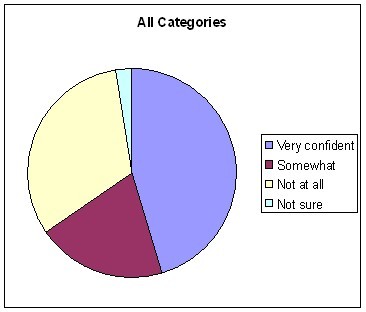


Very confident that Bush won fair and square -- 45.2%
Somewhatconfident that Bush won fair and square -- 20.0
Not at all confident that he won fair and square -- 32.4
Other/not sure -- 2.4


This is a remarkable result. Nearly two years into the second term of his presidency, less than half of those polled think that the 2004 election victory was “fair and square.” 20% say they are “somewhat” confident, which is hardly an endorsement of legitimacy. Webster’s defines “somewhat” as follows: “…in some degree or measure: SLIGHTLY.“ This does not exactly qualify as an endorsement of a critical democratic process. The 32% who are “not at all confident” represent a huge portion of the population believing that Bush failed to win without cheating. Combining “not at all confident” with “somewhat” “slightly”, according to Webster’s, produces a category of 52% who “doubt” the legitimacy of the election. Altogether, these results are a clear vote of no confidence.


Combining “not confident at all” and “somewhat” (“in some degree measure: SLIGHTLY”) produces a category of “Doubts.” This gives a clear picture on legitimacy versus illegitimacy issue.
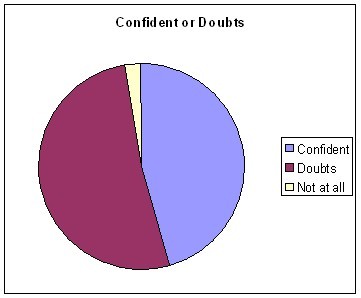


Those who doubt: Not at all confident that he won fair and square - 32%

Fifty nine percent of Democrats, 5% of Republicans, and 34% of independents comprise the group with no confidence in a Bush win. Dividing the group by race shows that 54% of Asians and 71% percent of African Americans have serious doubts in the legitimacy of the election, along with 25% of whites and 37% of Latinos. Thus, a majority of Asian and African American voters lack confidence in the president’s legitimacy to rule while significant numbers of whites and Latinos do as well.

Groups thought to be in the hip pocket of the Republican administration show no confidence at a significant rate. NASCAR fans doubt the election results at a rate of 28% and born again Christians at 25%. Those in rural areas and the suburbs show some real doubt with rates of 28% and 29% respectively demonstrating a significant level of doubt. Members of the armed forces were right at the survey average with 32% questioning the legitimacy of the election.
FULL TEXT:

Link: http://www.scoop.co.nz/stories/HL0609/S00346.htm
Print version: http://www.scoop.co.nz/stories/print.html?path=HL0609/S00346.htm

Michael Collins is a writer who focuses on clean elections and voting rights. He is the publisher of the web site, www.ElectionFraudNews.com . His articles in “Scoop” Independent News can be found here. MichaelCollins@electionfraudnews.com


<

Friday, September 22, 2006

CIA ‘refused to operate’ secret jails

I heard this on Democracy Now this morning, still the one hour of radio news you need to listen to everyday.

Our one hope for preventing the Bush administration from invading Iran and starting a world war isn't protesters or even elected Democrats, but a rebellion by the CIA and military.

Pulitzer Prize winning journalist Seymour Hersh of the New Yorker has documented the Pentagon generals dissent to Bush's goals and methods, and Sidney Blumenthal of Salon just published a book that documents how Bush has essentially been at war with the military since 2002 when they began to tell him what would happen if we invaded Iraq.

Right now, when generals dissent, they are forced to retire, which has a downside for the Bushies: they are then free to air their gripes PUBLICLY, which they are doing.

Either the Bushies will push things to the point that the military does what the CIA did in the case of secret prisons (simply refuse to follow orders) or they will realize that is the likely outcome and quietly start packing their bags for their retirement in Saudi Arabia (I think Idi Amin's cabana is now available).

There is something wrong with our democracy when the only way change can happen that a majority of Americans want is when government employees rebel. Our elected officials are not representing us, certainly not the Republicans, but sadly neither are a large number of Democrats.


KEY EXCERPTS:


http://www.ft.com/cms/s/57e68ed8-48da-11db-a996-0000779e2340.html


CIA ‘refused to operate’ secret jails

By Guy Dinmore in Washington

Published: September 20 2006 22:07 | Last updated: September 20 2006 22:07

The Bush administration had to empty its secret prisons and transfer terror suspects to the military-run detention centre at Guantánamo this month in part because CIA interrogators had refused to carry out further interrogations and run the secret facilities, according to former CIA officials and people close to the programme.

***

The administration publicly explained its decision in light of the legal uncertainty surrounding permissible interrogation techniques following the June Supreme Court ruling that all terrorist suspects in detention were entitled to protection under Common Article Three of the Geneva Conventions.

But the former CIA officials said Mr Bush’s hand was forced because interrogators had refused to continue their work until the legal situation was clarified because they were concerned they could be prosecuted for using illegal techniques. One intelligence source also said the CIA had refused to keep the secret prisons going.

FULL TEXT:

http://www.ft.com/cms/s/57e68ed8-48da-11db-a996-0000779e2340.html


public relations

Wednesday, June 14, 2006

World opinion of US falls again

Most of the people polled think the Iraq War is making the world a more dangerous place not less, and the opinion of us in the Arab world keeps going from low to lower--which isn't exactly a sign that terrorism is less likely because of Bush's wars. But then, another terrorist attack would be a good excuse to attack Iran, as Dick Cheney told the Pentagon last summer.

The previous Pew Poll on this was bad enough. This shows the trend is continuing.

Apparently, without Fox News, Rush Limbaugh, and Ann Coulter, the Arab world hasn't realized we are doing them a favor by killing Iraqis and restructuring their economy to favor our oil companies, corporations, and banks. (Oh wait, I forgot. The right never mentions that stuff) Or maybe they don't believe our new love for democracy in the region since we are still allies with dictators in the region like the Saudis, often the number one human rights abuser in the world, and the president of Uzbekistan, who boils his critics alive.

But those countries made deals our oil companies like, so they don't see the need to call in airstrikes to stop the beheadings and boilings.

The one piece of good news is people have a high regard for Americans in general. The albatross around our neck is Bush & his policies. A good example is Turkey. While 12% have a favorable impression of the US (pretty bad for a secular Muslim ALLY), but their favorable impression of Bush is 3%. The margin of error was 2-4%, so it is possible that he actually got a negative 1%, comparable to Bush's approval ratings with African Americans after Hurricane Katrina.

Bush does still have a slightly higher approval rating than ebola, AIDS, and cannibalism. Maybe he can build on that success.

KEY EXCERPTS:
International Herald Tribune
Image of U.S. falls again
By Brian Knowlton International Herald Tribune
WEDNESDAY, JUNE 14, 2006

WASHINGTON As the war in Iraq continues for a fourth year, the global image of America has slipped further, even among publics in countries closely allied with the United States, a new global opinion poll has found.

Favorable views of the United States dropped sharply over the past year in Spain, where only 23 percent now say they have a positive opinion, down from 41 percent in 2005, according to the survey, which was carried out in 15 nations this spring by the Pew Research Center. In Britain, Washington's closest ally in the Iraq war, positive views of America have remained in the mid-50s in the past two years, still down sharply from 75 percent in 2002.

Other countries where positive views dropped significantly include India (56 percent, down from 71 percent since 2005); Russia (43 percent, down from 52 percent); and Indonesia (30 percent, down from 38 percent).

In Turkey, a NATO ally of the United States, only 12 percent said they held a favorable opinion, down from 23 percent last year.

***

The ebbing of positive views of the United States coincides with a spike in feeling that the war in Iraq has made the world a more dangerous place. This perception was shared by majorities in 10 of the countries surveyed, including Britain, where 60 percent said the world had become more dangerous since Saddam Hussein's removal from power in 2003.

Over the past year, support for the U.S.-led fight against terrorism also declined again, Pew found.

***

Many respondents distinguished between their largely negative feelings about President George W. Bush and their feelings about ordinary Americans. Majorities in 7 countries polled had favorable views of Americans, led by Japan, at 82 percent, and Britain, at 69.

But only in India and Nigeria did majorities express confidence in Bush. In Spain, just 1 in 14 respondents registered confidence in him, as did only 1 in 33 in Turkey, an important NATO ally.

FULL TEXT:

http://www.iht.com/articles/2006/06/13/news/pew1.php


public relations

Saturday, June 10, 2006

3 things about killing Zarqawi

At all the other major turning points in the war in Iraq, when Bush declared combat operations over, the hand-over of sovereignty, the capture of Saddam, and the various elections, I at least wondered for a moment if it might not be a turn for the better.

With this hooha over the death of Zarqawi, I didn't even wonder. It won't make a difference.

Here's a couple of reasons why:

1. The military admits they inflated Zarqawi's role in the insurgency for propaganda purposes in both Iraq and the US.


From the Washington Post:

For the past two years, U.S. military leaders have been using Iraqi media and other outlets in Baghdad to publicize Zarqawi's role in the insurgency. The documents explicitly list the "U.S. Home Audience" as one of the targets of a broader propaganda campaign.

Some senior intelligence officers believe Zarqawi's role may have been overemphasized by the propaganda campaign, which has included leaflets, radio and television broadcasts, Internet postings and at least one leak to an American journalist. Although Zarqawi and other foreign insurgents in Iraq have conducted deadly bombing attacks, they remain "a very small part of the actual numbers," Col. Derek Harvey, who served as a military intelligence officer in Iraq and then was one of the top officers handling Iraq intelligence issues on the staff of the Joint Chiefs of Staff, told an Army meeting at Fort Leavenworth, Kan., last summer.

http://www.washingtonpost.com/wp-dyn/content/article/20...


2. Israeli and Saudi studies of foreign fighters show most aren't al Qaeda or pirmarily religiously motivated.


From the Boston Globe:

Other fighters, who are coming to Iraq from across the Middle East and North Africa, are older, in their late 20s or 30s, and have families, according to the two investigations. ''The vast majority of them had nothing to do with Al Qaeda before Sept. 11th and have nothing to do with Al Qaeda today," said Reuven Paz, author of the Israeli study. ''I am not sure the American public is really aware of the enormous influence of the war in Iraq, not just on Islamists but the entire Arab world."

http://www.boston.com/news/world/middleeast/articles/20...


3. Top GOP strategist Grover Norquist said back in January this was part of their plan to win the November 2006.


...And then for the coup de grace, says Norquist, his baby face breaking into a wide grin: "We'll bring in al-Zarqawi and Osama Bin Ladin."

http://www.huffingtonpost.com/al-bardach/ken-mehlman-th...

That Osama trick would only work if they did it a few days before the election--maybe even the day OF the election, so people stay home to watch the news instead of go out to vote.

***

UPDATE: The day after I wrote the entry above, Zogby released a poll saying catching Osama wouldn't help Bush at all:

Asked how much credit would be due President Bush if bin Laden were caught,

52% said they would give him no credit because he turned his attention instead to Iraq after the war in Afghanistan.

28% would give him all the credit, while

17% said he would deserve some of the credit.

The President’s job approval rating in fighting against terrorism would be at 42% if bin Laden were found, the poll shows, which is about where he is right now – with bin Laden still on the loose.
I would not have guessed this. I would expect Bush and Republicans generally to get some kind of bump in the polls if Osama was caught or killed, and the only question would be how big a bump and how long lasting. My guess would be lower and shorter than most people think, but I base that on the capture or killing of other boogey men like Saddam, his sons, and earlier domestic horrors like Tim McVeigh or the Unabomber.

Once the boogeyman is neutered, he instantly shrinks from larger than life threat to curiosity at best. If we had captured Hitler alive and kept him in a cage so people could throw peanuts at him, it's doubtful the Nazis would still have the place in the public imagination as the ultimate villains in history.


public relations

Tuesday, June 06, 2006

GOP: Masters of the Obvious

Americans should speak English.

Marriage is between a man and a woman.

Flag burning is bad.

Did you ever know someone who had an annoying habit of pointing out the obvious? Like saying, "That looks heavy!" instead of helping you carry it or telling you to do something you were about to do anyway? By grade school, this is usually met with "DUH!" "DOI!" or "No shit, Sherlock." In college, a slightly more diplomatic friend used to say "Thanks, MOTO (master of the obvious)."

Not that I agree with GOP on these things, but when was the last time you felt the need for a law to let you know which language would be most useful to speak? Did you ever get up and wonder if today was a Portuguese day or maybe Hindi?

Were you ever uncertain about which gender to marry or date and wish there was a federal law or even constitutional amendment to clear it up for you?

Were you ever uncertain whether burning the American flag is a sign of respect or disrespect?

Most of us feel pretty competent to figure this stuff out for ourselves. Apparently, a lot of Republicans don't.

In fairness, they will be quick to tell you that they PERSONALLY wouldn't marry someone of the same sex just because it was legal, but someone else might be weaker than them, and their children's sexual orientation is apparently as abitrary as their taste in music or clothes, subject not only to fads but the fad of a distinct minority.

That makes sense though since these are the same people that think their children will forsake their religious beliefs if they don't hear about God during the six hours of the public school day. The parents themselves might become stone atheists if "In God we trust" wasn't on our money so they could pull it out and read it when they start to doubt his existence.

Their thought processes are a closed loop: I have a prejudice, I want society to make it a law, so I can point to the law to show that my prejudice is valid.

They never ask a question that requires evidence or that they haven't already decided what the answer is. If most of us were concerned about whether Terri Schiavo's husband was ending her life while she still had a chance for recovery, we would then want to hear about the tests of her brain activity, see CAT scans, and things like that before we were certain he was doing something wrong. If most of us were vaguely uncomfortable with gays and wonder if gay marriage influenced kids to be gay, we would want to see research by psychologists, sociologists, neurologists and other scientists before we decided it was a legitimate concern,, and we might actually change our minds. Not the MOTOs. They have a prejudice, Pastor Buford and President Bush confirm it, and that's the end of the discussion.

We all have our moments when we are the Sherlock of "No shit, Sherlock," but when someone does nothing but point out the obvious or make rules about things most people were going to do anyway, you begin to wonder if they aren't a little retarded, and rather than argue or agree with them, you try to steer clear of them and put important things on shelves they can't reach.

I don't think republican politicians are retarded. They are just profoundly cynical like an ice cream man who whispers in kids' ears that he'll sell them boogey man protection if they give him their lunch money or let him touch their little brother in the back of the truck.

We aren't doing the GOPs constituents any favors by treating their hot button issues as legitimate concerns any more than we would be helping the retarded kid by asking him if his boogey man insurance is all paid up to date.


master of the obvious