Thursday, November 29, 2007

intercepted CIA memo on attacking democracy in Venezuela

If you have only heard bad things about Hugo Chavez in the media, you might not have heard that his election, re-election, and triumph in a US-backed recall by wide margins were certified by international monitors, and that network whose broadcast license he refused to renew actively helped the US backed coup against Chavez and bragged about it on the air while the coup was going on. He also refused the IMF economic program that would have cut social spending and left Venezuela with only 1% of their oil income, the rest going to oil companies and the debt run up by past corrupt governments.


And if you believe the criticism of him in the media, consider what our ally, the kingdom of Saudi Arabia, is doing right now: sentencing a gang rape victim to 200 lashes for being in the company of men. There is no election of the Saudi family, recall, or referendum on their power, but the CIA isn't trying to remove them because big oil thinks they've already got the best deal they can get there.

Now there is another vote in Venezuela on amending their constitution, and even the CIA concedes 57% of Venezuelans support Chavez.

That is not stopping them from planning the kind of economic disruption and military take over that led to the coup in Chile in 1973 and decades of torture, mass executions, and economic policies that enriched a handful of the already wealthy and eroded the middle class.

The only problem with doing this in Venezuela is Chavez is FROM the military, and most of the military sided with him when a coup was attempted before because they were sick of being the bad guys and oppressing their own people.

Attacking Chavez is not only morally wrong, but economically foolish. Like Iran, the best weapon Venezuela has to retaliate is economic--they can simply accelerate the move away from trading oil in dollars, drying up the money and credit Bush needs to continue his wars.

If we were really concerned about reducing terrorism and having a stable supply of oil, we would work with leaders like Chavez and work to destabilize big oil instead.

KEY EXCERPTS:

The memo sent by an embassy official, Michael Middleton Steere, was addressed to the Director of Central Intelligence, Michael Hayden. The memo was entitled 'Advancing to the Last Phase of Operation Pincer' and updates the activity by a CIA unit with the acronym 'HUMINT' (Human Intelligence) which is engaged in clandestine action to destabilize the forth-coming referendum and coordinate the civil military overthrow of the elected Chavez government. The Embassy-CIA's polls concede that 57 per cent of the voters approved of the constitutional amendments proposed by Chavez but also predicted a 60 per cent abstention.

The US operatives emphasized their capacity to recruit former Chavez supporters among the social democrats (PODEMOS) and the former Minister of Defense Baduel, claiming to have reduced the 'yes' vote by 6 per cent from its original margin. Nevertheless the Embassy operatives concede that they have reached their ceiling, recognizing they cannot defeat the amendments via the electoral route.

The memo then recommends that Operation Pincer (OP) be operationalized. OP involves a two-pronged strategy of impeding the referendum, rejecting the outcome at the same time as calling for a 'no' vote. The run up to the referendum includes running phony polls, attacking electoral officials and running propaganda through the private media accusing the government of fraud and calling for a 'no' vote. Contradictions, the report emphasizes, are of no matter.

The CIA-Embassy reports internal division and recriminations among the opponents of the amendments including several defections from their 'umbrella group'. The key and most dangerous threats to democracy raised by the Embassy memo point to their success in mobilizing the private university students (backed by top administrators) to attack key government buildings including the Presidential Palace, Supreme Court and the National Electoral Council. The Embassy is especially full of praise for the ex-Maoist 'Red Flag' group for its violent street fighting activity. Ironically, small Trotskyist sects and their trade unionists join the ex-Maoists in opposing the constitutional amendments. The Embassy, while discarding their 'Marxist rhetoric', perceives their opposition as fitting in with their overall strategy.

The ultimate objective of 'Operation Pincer' is to seize a territorial or institutional base with the 'massive support' of the defeated electoral minority within three or four days (presumably after the elections though this is not clear. JP) backed by an uprising by oppositionist military officers principally in the National Guard. The Embassy operative concede that the military plotters have run into serous problems as key intelligence operatives were detected, stores of arms were decommissioned and several plotters are under tight surveillance.

Apart from the deep involvement of the US, the primary organization of the Venezuelan business elite (FEDECAMARAS), as well as all the major private television, radio and newspaper outlets have been engaged in a campaign of fear and intimidation campaign. Food producers, wholesale and retail distributors have created artificial shortages of basic food items and have provoked large scale capital flight to sow chaos in the hopes of reaping a 'no' vote.


FULL TEXT


Monday, November 26, 2007

The Myth of the Oil Weapon vs. Reality of Corporate Oil Thieves

Someone at the American Conservative took the time to debunk one of the less embarrassing lies about why we invaded Iraq: to secure "strategic access" to their oil in case some future Iraqi government or other producers threaten to cut us off or dramatically increase prices.

The author points out the obvious problem that if your economy depends on the sale of one product, you can't cut off the customer who uses 25% of it and expect to make money. Likewise, the more one player tries to jack up the price, the more temptation there will be for competitors to produce more to capture those added profits, and the price will go back down as demand increases.

He leaves out the other effect of high prices: it will make alternative fuel and energy sources more attractive to more people.

If we really just wanted "strategic access," we would go after it the way China is doing in Iran, Canada, and Africa: with long term contracts and inducements to friendship not wars, which tend to alienate people and cost more than paying them.

I don't believe those in the White House actually believe they need to seize the oil to prevent a future embargo. They just want to give a $10-30 trillion gift to their friends in big oil, and control of the spigot, so they could control how much is produced and therefore the price.

EVIDENCE FOR WAR TO KEEP OIL PRICES HIGH

VALUE OF IRAQI OIL

This is the ultimate in corporate welfare. We pay for the war, and oil companies collect the profits, which they don't have a very good track record of sharing with us.

The Myth of the Oil Weapon
November 5, 2007 Issue
The American Conservative

Our foreign-policy establishment believes the U.S. must intervene to keep oil flowing from the Mideast. In reality, all America needs to do is demand it.


by David R. Henderson

In a recent interview with Charlie Rose to drum up publicity for his book, The Age of Turbulence, former Federal Reserve Chairman Alan Greenspan argued that the reason to make war on Iraq was that an unchecked Saddam Hussein would have threatened the world’s oil supply. Greenspan gave no evidence or argument for his assertion. But in making it, he confirmed the views of many opponents of the war, and even some supporters, that the Iraq War was, or at least should have been, about oil. He also joined a long list of prominent people who have made the case for war for oil ever since the Organization of Petroleum Exporting Countries formed an effective cartel that raised the world price from $3 a barrel to $11 in the fall of 1973.

That’s too bad, because the case for making war for oil is profoundly weak.
The pragmatic case against war for oil, on the other hand, rests on a few simple facts. First, no oil-producing country, no matter what it does to its oil supply, can cause us to line up for gasoline. Second, an oil-producing country cannot impose a selective embargo on a target country, because oil is sold in a world market. Third, the only way one country’s government can hurt another country using the “oil weapon” is by cutting output, which hurts all oil consumers, not just the target country; helps all oil producers, friend and foe alike; and harms the country that cuts its output.


Consider how long the foreign-policy establishment has taken as accepted the idea that the U.S. government needs to use military force to keep the world’s oil supply flowing. In March 1975, Harper’s published an article, “Seizing Arab Oil,” authored by “Miles Ignotus.” The author’s name, Harper’s explained, “is the pseudonym of a Washington-based professor and defense consultant with intimate links to high-level U.S. policy makers.” Many insiders speculated that the piece was written by Edward Luttwak, still a prominent military analyst. In it, the author expressed frustration at the high price of oil and argued that no nonviolent means of breaking the cartel’s back would work. Even massive conservation, he argued, was unlikely to solve the problem. Moreover, he claimed, “there is absolutely no reason to expect major new discoveries.” So what options were left? “Ignotus” wrote, “There remains only force. The only feasible countervailing power to OPEC’s control of oil is power itself—military power.” He argued at the time that military force should be exerted on Saudi Arabia.

***

When many Americans over age 50 worry about Middle Eastern producers playing havoc with the world oil supply, they think back to the gasoline lines of 1973 and 1979. But those fiascos weren’t forced by a foreign producer. The U.S. government was responsible. President Nixon had imposed a freeze on all prices on Aug. 15, 1971. He gradually decontrolled prices, but when OPEC raised the price in the fall of 1973, Nixon’s price controls prevented the price of oil and gasoline from rising sufficiently. Whatever else economists may argue about, they agree that a price control that keeps the price below what would have otherwise existed in a competitive market will cause a shortage. The reason is that at a price below the competitive price, consumers will demand more and producers will supply less. President Ford and Congress altered the price controls, and President Carter inherited and kept them. When the world oil supply tightened again in 1979, we had another shortage. Simply by refraining from controlling the price, therefore, we can avoid, and have avoided, gas lines.

FULL TEXT

MORE IRAQ OIL THEFT RESOURCES


Saturday, November 03, 2007

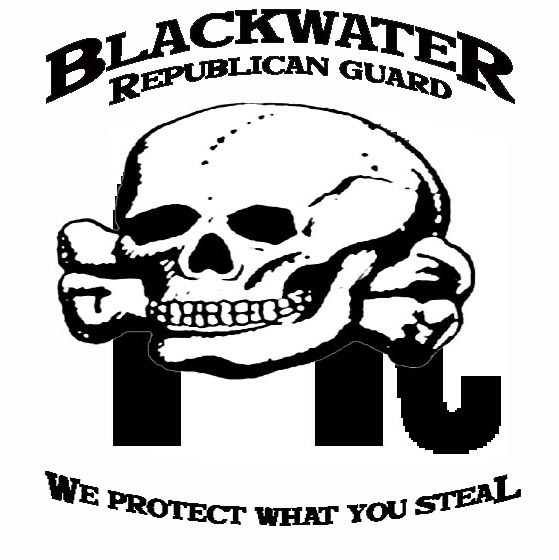
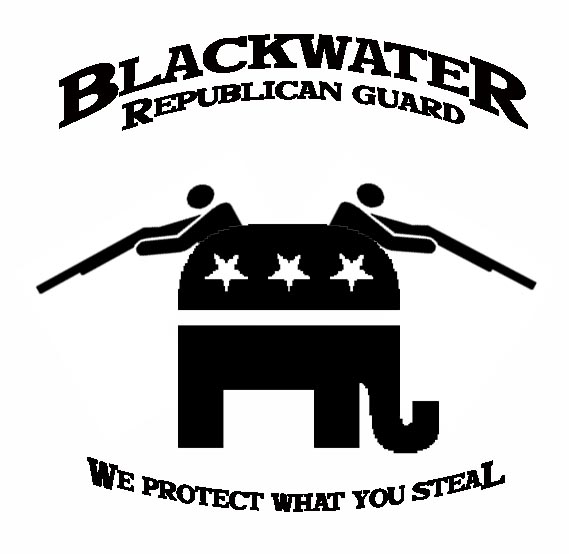
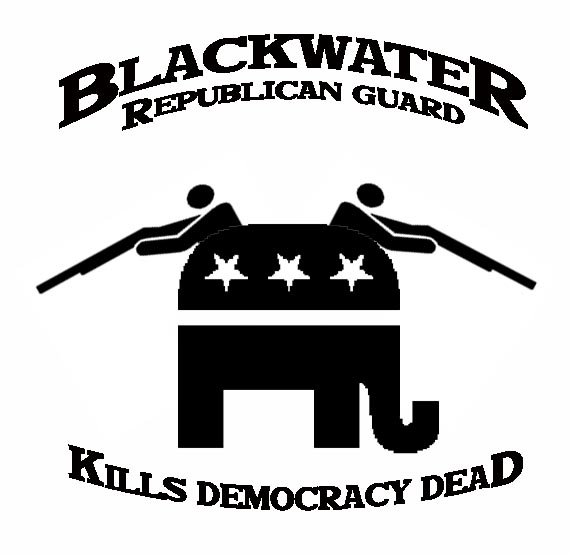
Blackwater mercenary logo contest: my entries


Blackwater, the Republican mercenary company, recently changed their logo, removing crosshairs to make it look less violent.

This inspired Wired to run a contest to design a better logo. Here's my efforts followed by my favorites of other people's:


MINE:


OTHER PEOPLE'S EFFORTS:

This is a reference to a SOUTH PARK reference to COOL HAND LUKE. Cartman is saying, "Respect mah authoritay!!!!"


Order early for this holiday season:

click to see full-sized album cover

More entries in the wired contest


Wednesday, October 24, 2007

Iraq War happy ending in sight: Iraqis keep oil, Bush & cronies get nothing

Despite hundreds of thousands of dead, and their country salted with depleted uranium, the Iraqis may yet take control of their democracy and natural resources--IN SPITE of Bush, not because of him.

From before the start of the war, the Bush administration planned to privatize and sell off everything in Iraq to their cronies at bargain basement prices, especially the oil.

The Bushies one mistake is they thought the Iraqis are as stupid as the average Fox News viewer, and would believe whatever hatful of shit propaganda he dished out, and if they didn't, they could scare the Iraqis into obedience by picking up people at random and torturing and raping them at Abu Ghraib.

The Iraqis knew why Bush was there though, and even after Bush vetoed their choice for prime minister and approved his replacement and then threatened him with firing, the Iraqis refused to sign away their oil wealth to Bush's corporate cronies.

If the Iraqis are successful in hanging onto their oil, it might just shave a few years off the hatred Bush has earned for us. But it won't bring back the grandmothers and babies crushed in rubble or the arms burned off a boy in the initial and on-going shock and awe air strikes.
KEY EXCERPTS:

Tomgram: Jack Miles, Baghdad to Bush: You Have 14 Months

By December 31, 2008, according to Foreign Minister Hoshyar Zebari, the government of Iraq intends to have replaced the existing mandate for a multinational security force with a conventional bilateral security agreement with the United States, an agreement of the sort that Washington has with Kuwait, Saudi Arabia, and several other countries in the Middle East. The Security Council has always paired the annual renewal of its mandate for the multinational force with the renewal of a second mandate for the management of Iraqi oil revenues. This happens through the "Development Fund for Iraq," a kind of escrow account set up by the occupying powers after the overthrow of the Saddam Hussein regime and recognized in 2003 by U.N. Security Council Resolution 1483. The oil game will be up if and when Iraq announces that this mandate, too, will be terminated at a date certain in favor of resource-development agreements that -- like the envisioned security agreement -- match those of other states in the region.

The game will be up because, as Antonia Juhasz pointed out last March in a New York Times op-ed, "Whose Oil Is It, Anyway?":

"Iraq's neighbors Iran, Kuwait and Saudi Arabia…. have outlawed foreign control over oil development. They all hire international oil companies as contractors to provide specific services as needed, for a limited duration, and without giving the foreign company any direct interest in the oil produced."

By contrast, the oil legislation now pending in the Iraqi parliament awards foreign oil companies coveted, long-term, 20-35 year contracts of just the sort that neighboring oil-producers have rejected for decades. It also places the Iraqi oil industry under the control of an appointed body that would include representatives of international oil companies as full voting members.

The news that the duly elected government of Iraq is exercising its limited sovereignty to set a date for termination of the American occupation radically undercuts all discussion in Congress or by American presidential candidates of how soon the U.S. occupation of Iraq may "safely" end. Yet if, by the same route, Iraq were to resume full and independent control over the world's third-largest proven oil reserves -- 200 to 300 million barrels of light crude worth as much as $30 trillion at today's prices -- a politically incorrect question might break rudely out of the Internet universe and into the mainstream media world, into, that is, the open: Has the Iraq war been an oil war from the outset?

***
Clearly, some in Washington still think so. Shortly before the collapse of the Iraqi oil legislation effort, Bush's Commerce Department began quietly advertising for an Arabic-speaking legal advisor to help it in "providing technical assistance to Iraq to create a legal and tax environment conducive to domestic and foreign investment in Iraq's key economic sectors, starting with the mineral resources sector." (Read: starting with oil.) As it happens, the job description overlaps heavily with that of the Development Fund for Iraq's existing International Advisory and Monitoring Board, whose responsibility, according to U.N. Security Council Resolution 1483, has been to see to it "that all export sales of petroleum, petroleum products, and natural gas from Iraq…. shall be made consistent with prevailing international marketing best practices." Is the Commerce Department already planning for the demise of this board? Like the super-embassy and the super-bases, this bit of Commerce Department staffing-up bespeaks the urge to continue an invasive American presence in Iraq, including Iraq's energy sector, long after December 31, 2008.

But if the occupation is shut down legally after that date and if Iraqi control over Iraqi oil reverts -- legally, at least -- to something close to pre-war status, that Commerce Department expert may find him or herself playing a less-than-major role in Baghdad. Instead, expect a new role for Iraq's hitherto excluded pool of domestic expertise. The Iraq National Oil Company began operations back in 1961; its legacy includes a skilled work force of trained oil workers. Notable, in fact, among those opposed to the failed oil legislation is the Iraqi Federation of Oil Unions. Its members object to provisions in the legislation that permit the hiring of foreign oil workers rather than Iraqis and -- in classic Bush Administration fashion -- exclude the union from any participation in contract negotiations. The Federation's protests have attracted a letter of support signed by six Nobel Peace Prize laureates.


FULL TEXT


MORE IRAQ OIL THEFT RESOURCES