Friday, August 15, 2008

Georgia & Russia all about OIL

The US is trying to cut Russia out of the profits and control of Caspian Sea oil. There is no other story in Georgian-Russia conflict, there are only details about innocent bystanders caught in the crossfire.

The way our network news covers it is a little like talking about the aftermath of the bombing of Hiroshima without mentioning the atom bomb. But they are only following the lead of our elected officials.

It is to the undying shame of American democracy that this is not part of what our elected leaders tell us about the decisions they are making.

KEY EXCERPTS:


Russia and Georgia: All About Oil

Michael Klare | August 13, 2008


This struggle commenced during the Clinton administration when the former Soviet republics of the Caspian Sea basin became independent and began seeking Western customers for their oil and natural gas resources. Western oil companies eagerly sought production deals with the governments of the new republics, but faced a critical obstacle in exporting the resulting output. Because the Caspian itself is landlocked, any energy exiting the region has to travel by pipeline – and, at that time, Russia controlled all of the available pipeline capacity. To avoid exclusive reliance on Russian conduits, President Clinton sponsored the construction of an alternative pipeline from Baku in Azerbaijan to Tbilisi in Georgia and then onward to Ceyhan on Turkey’s Mediterranean coast -- the BTC pipeline, as it is known today.

The BTC pipeline, which began operation in 2006, passes some of the most unsettled areas of the world, including Chechnya and Georgia’s two breakaway provinces of Abkhazia and South Ossetia. With this in mind, the Clinton and Bush administrations provided Georgia with hundreds of millions of dollars in military aid, making it the leading recipient of U.S. arms and equipment in the former Soviet space. President Bush has also lobbied U.S. allies in Europe to “fast track” Georgia’s application for membership in NATO.

All of this, needless to say, was viewed in Moscow with immense resentment. Not only was the United States helping to create a new security risk on its southern borders, but, more importantly, was frustrating its drive to secure control over the transportation of Caspian energy to Europe. Ever since Vladimir Putin assumed the presidency in 2000, Moscow has sought to use its pivotal role in the supply of oil and natural gas to Western Europe and the former Soviet republics as a source both of financial wealth and political advantage. It mainly relies on Russia’s own energy resources for this purpose, but also seeks to dominate the delivery of oil and gas from the Caspian states to the West.

FULL TEXT


Wednesday, August 13, 2008

We treated Post-Soviet Russia like Post-WW I Germany: why expect different outcome?

After World War I, the Allies imposed brutal terms on the defeated Germans, imposing not only reparations for war costs, but maintaining a starvation blockade AFTER surrender, and stripping Germany of territory.

After the Fall of the Soviet Union, we had a chance to steer Russia toward a stable, European-style social democracy.

Instead, the Wall Street types insisted that any economic aid come at the price of radical free market reforms that actually lowered the standard of living and even life expectancy compared to Soviet days.

Likewise, the breaking away of former Soviet Republics may have been inevitable, but their quick integration into NATO and America siding strongly with political candidates in those countries based on how quickly they would open up to foreign investments. shed their social safety net, and allow us to use their soil as a base for military operations was a continual slap in the face of the critically injured but not dead Russia.

There are, however, a couple of critical differences between Germany after WWI and Russia after Communism.

Germany was a great industrial power, which could make her a powerful military adversary but she was poor in the natural resource to power expansionist ambitions: oil. Hitler didn't seize enough oil-rich territory in time to fight the allies indefinitely and ran out of gas.

By contrast, Russia sits on the Caspian Sea Basin, where some of those oil reserves Hitler needed were, and American oil companies are trying to quietly pick them out of Russia's pocket, one former republic and pipeline at a time. One of those is in Georgia.

We have not only beaten Russia, we have taken their watch and are now trying to pry loose their fillings. How would you expect them to respond?

Russia also correctly sees us as trying to control all of the major oil producing countries in the Persian Gulf, adding occupied Iraq to our "ally" Saudi Arabia, and now Bush & Cheney are eying Iran's reserves as well. Would we allow Russia to gain control of so much of the world's oil and on top of that, cozying up to Mexico to suck oil from under our border?

Another way Russia is unlike Germany is Russia has about as many nuclear warheads as we do, and unlike the phantom menace from Iraq, Russia has the means to deliver them and a possible motive. This makes the Wall Street post-communist plan to belittle and plunder Russia suicidal. If you beat someone to pulp and keep pounding, if the only weapon he has to fight back is a hand grenade, he just might pull the pin even if it means killing himself as well as you.

Our Wall Street first foreign policy has led us into a costly war in Iraq, and if we attack Iran or make a misstep on Georgia, it could lead to World War that could cost billions of lives. And whichever corporations profit from the war, none of them will share the loot with average Americans anymore than they are sharing their massive profits from running up the price of oil with wars and threats of war.

The great flaw of the Wall Street first foreign policy is it expects people to respond like sheepish employees given the pink slip and escorted out of the office. But when you are being forcibly removed from your means of survival, as is the case in Iraq, and we are now seeing in Russia, people do not go quietly, and more innocent bystanders than guilty parties end up dead.

Peace with dignity and security for all parties involved may mean less short term profits for Wall Street speculators, but as we saw with the Marshall Plan after World War II, a well-fed and well-treated former adversary doesn't take up arms against you again, and both sides can prosper.

We must choose between modest profits for most, stability and life for all, or quick profits for a few, and war and death for everyone else.


Saturday, August 02, 2008

FORGOTTEN HISTORY: Bush admits no Saddam 9/11 link in 2004 debate

With another presidential election at hand, and terror alerts and odd events about to descend upon us again, it's worth remembering that President George W. Bush admitted during a 2004 presidential debate that the country we invaded and now occupy to the tune of up to trillions of tax dollars spent, over a million Iraqis killed, and thousands of American troops killed and tens of thousands maimed for life, had nothing to do with 9/11.

Nothing.

Bush admitted Iraq had nothing to do with 9/11 at least three times.

  1. Once in response to polls showing his propaganda had convinced 70% of the public that Iraq was involved in 9/11,

  2. in 2006 when a reporter accidentally asked an important question,

  3. and in 2004 during a debate with Senator John Kerry (see below).

Kerry was not the perfect candidate, but at least in this exchange, he had the better handle on reality; or more precisely, he acknowledged reality whereas Bush lied about and tried to change the subject.

KEY EXCERPTS:

BUSH: I would hope I never have to. I understand how hard it is to commit troops. Never wanted to commit troops. When I was running -- when we had the debate in 2000, never dreamt I'd be doing that.

But the enemy attacked us, Jim, and I have a solemn duty to protect the American people, to do everything I can to protect us....

KERRY: Jim, the president just said something extraordinarily revealing and frankly very important in this debate. In answer to your question about Iraq and sending people into Iraq, he just said, "The enemy attacked us."

Saddam Hussein didn't attack us. Osama bin Laden attacked us. Al Qaida attacked us. And when we had Osama bin Laden cornered in the mountains of Tora Bora, 1,000 of his cohorts with him in those mountains. With the American military forces nearby and in the field, we didn't use the best trained troops in the world to go kill the world's number one criminal and terrorist...

He also said Saddam Hussein would have been stronger. That is just factually incorrect. Two-thirds of the country was a no-fly zone when we started this war. We would have had sanctions. We would have had the U.N. inspectors. Saddam Hussein would have been continually weakening...

LEHRER: Thirty seconds.

BUSH: First of all, of course I know Osama bin Laden attacked us. I know that.

FULL TEXT

Republicans have successfully sold themselves as the better party on national security, but when they lie to us on an issue as crucial as this, can we trust them with the safety of our country and families?


Friday, July 11, 2008

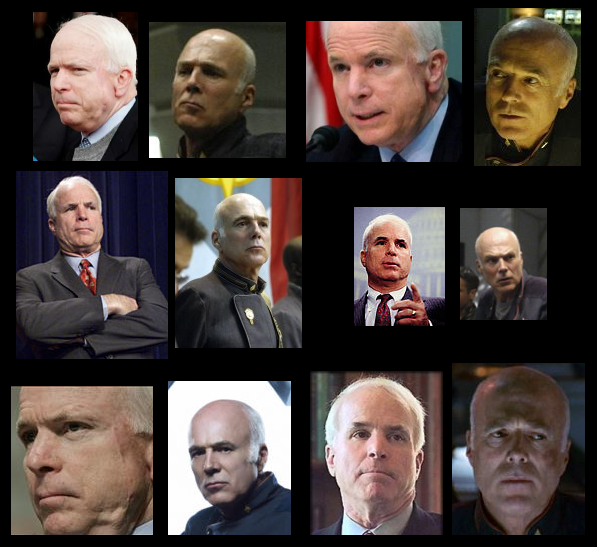
Is Battlestar Galactica's Col. Tigh modeled on McCain?

Others have noticed that John McCain bears an uncanny resemblance to Col. Tigh on BATTLESTAR GALACTICA.


McCain is the one on the--ah hell, I'm not sure. But one of them is him.

However, the resemblance is more than just skin-deep.

Consider:

Both are cranky old men, still working long after many of their peers have retired or died.

McCain was a POW who was tortured during the Vietnam War. Col. Tigh was a POW tortured by the Cylons and had his eye plucked out.

When McCain was released from Vietnam, he divorced his loyal first wife for a statuesque, blond hottie and has children with her. When Col. Tigh was released by the Cylons, he killed his loyal wife for betraying the resistance to secure his freedom. Later, Tigh hooks up with a statuesque, blond Cylon hottie and impregnates her.

John McCain verbally abused his hottie wife, calling her a "cunt" in public and saying she plasters on her make up like a trollop after she joked about his thinning hair. Col. Tigh verbally and physically abused his Cylon hottie because of his own conflicted feeling about being a Cylon himself.

John McCain thought he was in line for the presidency in 2000, only to be upstaged by the largely untested son of a former president. Col. Tigh took temporary command of Galactica only to be upstaged by Apollo, the largely untested son of the Admiral.

Most importantly, Col. Tigh thought he was a loyal colonial officer only to find out in his old age that he was one of his lifelong nemesis, the Cylons. If others knew his identity, his heroic record would be forgotten. John McCain thought he was a maverick, but finds himself a tool of the worst, most anti-democratic, corrupt, and dangerous president in American history, a man who insulted McCain's wife, his child, and his heroic military service. If the public realizes the degree to which he is a puppet of the same moneyed interests as Bush, his heroic record would be forgotten.

Col. Tigh has a drinking problem, and if I was John McCain, I would too.

I don't think McCain should be president, but since there are multiple copies of each human-looking Cylon, maybe McCain has a future as a guest star on BATTLESTAR GALACTICA, playing Col. Tigh's Cylon brother.


Sunday, July 06, 2008

Can Obama end our cancerous slavery to big oil dictated foreign policy?

The US Gas Garrison by Michael T. Klare has a good summary of the problem:

The Carter Doctrine, established 28 years ago, put the US military in service of assuring the nation’s regular supplies of imported oil. This has near-bankrupted the US and corrupted the military, yet left the US insecure in energy sources and globally loathed. The time has come to demote petroleum and stand down the troops.

FULL TEXT


In this brief summary, Michael T. Klare has handed the Democrats a bullet-proof issue for the fall (because it happens to be true).

I will add one more element to this: Bush is endangering the at least defensible goal of energy security with one that is not--forcing the Iraqis to give up most of the profits of their oil to big oil companies in the Hydrocarbon Law.

A possible result of this is that once our military is further weakened or we withdraw, Iraq could cancel contracts and laws they were coerced into signing, and cut off our oil as happened with the Saudi embargo in the 70s when they were mad at us for backing Israel in the Yom Kippur War, and when America lost any diplomatic influence over Iran after the revolution because we had backed the oppressive Shah for decades, and the Shah was installed because the OIL COMPANIES asked us to get rid of Iran's democratically elected president who wanted to nationalize their oil.

More recently, the demonization in the US press of the democratically elected Hugo Chavez of Venezuela has far more to do with how he treats oil companies than how he treats his own people. Bush backed one failed coup against him, but if he succeeds at another or has Chavez assassinated, the results will be still more disruption of the oil supply.

The greed of oil companies too often conflicts rather than dovetails with our needs for access and relatively low prices for oil.

If Obama is the candidate for change, this is the change we need most. Abraham Lincoln freed African Americans from slavery--will our first African American president free all of us from an oil industry that robs us not only of our wealth at the gas pumps, but our tax dollars to fight wars to seize oil reserves, and the lives of idealistic young soldiers who fight in those wars?

Oil Theft Motive for Iraq War resources


Wednesday, July 02, 2008

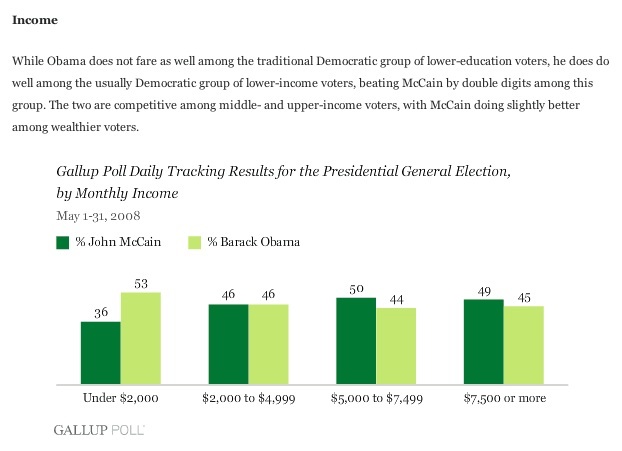
Gallup poll: Financial "elitist" is McCain

A favorite dig of the now defunct Hillary campaign and likely of McCain's once Karl Rove kicks into high gear is that Obama is some kind of elitist.

However, John McCain is the one with the back of the financial elite according to this Gallup poll, and Obama has the lead with people struggling to make ends meet.


People must be figuring out that the GOP is the party of Wall Street at the expense of Main Street. For all their talk of family values, patriotism, and religion, they would send your job to Bangladesh in a heartbeat, and if you are lucky enough to keep a job, they'll rob your paycheck by not regulating health insurance companies or checking the power of oil companies to jack up gas prices.

The evidence is pretty clear if you look at after tax income in the last couple of decades we have been guided by Republican economics:


The Republicans love the wealthy like their own family, and love the rest of us the way a lion loves a gazelle.


Tuesday, July 01, 2008

Iraqis say NO to profit sharing with big oil

The Iraqi oil ministry says big oil companies are dragging their feet about finalizing short term contracts because they want part of the profits of the oil, not just service contracts. It's a little like your gardener demanding you put his name on the deed to your house in exchange for mowing your lawn.

The Iraqis aren't stupid about this and said no.

Profit sharing is what the big oil companies demanded in the Hydrocarbon Law too, but the Iraqis are unlikely to ratify it with that in, given their hard line here.

It would be ironic if after a three trillion dollar war, over four thousand US soldiers dead, and over a million Iraqis dead, the oil companies got the same deal they would likely have gotten before the war.

Ironically, it is likely that the Iraqis are more eager to ramp up production than the major big oil companies. Before the war, Oil & Gas Journal said they were concerned that once the sanctions came off Iraq, they would pump too much and drive prices down. They would probably prefer to be in the driver's seat so they could set the pace to pad their profits rather than help out the Iraqis--or us.
KEY EXCERPTS:


Monday, June 30, 2008

Iraq offers oil contracts

Hussein al-Shahristani, the oil minister, told a news conference that the deals had not yet been concluded as the companies wanted a share of the profits.

"We did not finalise any agreement with them because they refused to offer consultancy based on fees as they wanted a share of the oil," he said.

Shahristani stressed that Iraq needed the services of experienced companies to realise the potential of its reserves but added that it was not ready to do so at any price.

"It is not possible for Iraq which has large oil reserves to stay at the current level of production. Iraq should be the second or the third source of oil exportation," the minister said.

"We went to these global companies and asked them to offer us consultancy but they will have no privileges or will not get a share of oil."

FULL TEXT

OIL THEFT MOTIVE FOR IRAQ WAR resources


UPDATE: Greg Muttitt at Hands Off Iraqi Oil has a less optimistic and more knowledge opinion of the current contract negotiations.