Sunday, May 01, 2005

Arguing with LA Times editor about electronic voting lack of coverage

NOTE: LA Times California Editor David Lauter's comments indented
Professor Smartass's comments aren't.

On Apr 25, 2005, at 10:42 AM, Lauter, David wrote:

Think back to what happened on election day: The exit poll starts gathering data first thing in the morning. Round about midday, preliminary results from the still-incomplete exit poll begin to dribble out onto the internet and rapidly get circulated. Those preliminary results showed Kerry leading and got a lot of people excited. Unfortunately, an incomplete exit poll is like a half-baked cake -- not fit for consumption. That's why the pollsters hate it when incomplete results get circulated -- they are often very misleading. (But in the era of the internet, there's not much you can do about that.) As the evening went on, and the poll was finished, the results began to shift and ended up in the other direction -- showing a Bush victory. By then, tho, no one was paying much attention to exit poll numbers because there were real results to look at. So there's this myth that's grown up that the exit polls showed a Kerry victory. They didn't.

The fact that the numbers shifted during the day was a pain in the neck for our reporters (and their colleagues at the NYT and WashPost) who were assigned to write analytical stories. They started the afternoon thinking they might be analyzing a Democratic win, but then, around 5 p.m. (pacific time), had to shift gears as the numbers shifted. But the fact that the polls were inconvenient to reporters (or briefly misleading to people who got incomplete numbers off the internet) isn't a page-one story.
I am a little over 40, so I can remember part of the evolution of this exit poll business. The policy of withholding results was not to make sure they got the numbers right, but as a courtesy to voters who hadn't gotten to the polls yet. Projection were made with fairly small percentages of precincts reporting that turned out to be remarkably, and maddeningly, accurate hence the need for the courtesy gag.

In this case, the shift in Ohio and a couple of other states came pretty late in the day, and the percentage change didn't jibe with the number of votes added to the result a couple of people bothered to take snapshots of the exit poll data on CNN and this is the basis of the concern that forced the exit polling companies to comment.

The after the fact explanation the exit polling companies felt compelled to give was that Republicans didn't talk to pollsters and voted late. In essence, they adjusted their polls to fit the vote count and came up with the explanation after the fact. If it was a Third World country or the Ukraine, we wouldn't consider it a conspiracy theory to say that something seems fishy.

In addition to the results not fitting the exit polls, they didn't fit the pre-election polls which were closer to a dead heat, Bush's job approval rating which barely hovered at 50% (a couple of points lower than his dad when he was defeated), and the tendency of undecided voters to break for the challenger among other things.

I don't recall ever having said that Republicans wouldn't rig an election. Sure some might if they thought it was necessary and they could get away with it. So might some Democrats. (Read Robert Caro on Lyndon Johnson's first election to the Senate if you want a well documented example). But conspiracies are much harder to put together (and even harder to hold together) than some writers like to believe. (It's not just a lone programmer who must be bought off for all time, it's also everyone the programmer talked to, the secretaries, the person who decided which precinct to fix and by how much, etc.) That's why historically, rigged elections have usually shown up in one-party areas where one side controlled all the levers of power and could be reasonably assured of immunity from investigation. (south Texas in the Johnson days, south Chicago under the late Mayor Daley, etc.) These days, in part because of the internet, there are many fewer such places, so the risk of exposure is much higher. That doesn't mean it can't happen. It does mean that you should exercise a certain healthy skepticism about claims of conspiracy and expect more in the way of proof than assertions about "Democratic Nebraska."

You have latched on to that Democratic Nebraska thing and ignored the more substantive elements of the story. While reporters have an obligation to get facts like that right, different people have different areas of expertise, and the voting machine story is largely the domain of nerdy number crunchers and computer programmers not political color commentators.

The more relevant part of the story is that Hagel owned the voting machine company that counted his votes. That's like the casino owner playing at his own blackjack table, or a lottery official buying a ticket--you'd be a little suspicious if they won.

The New York Times acknowledged in an editorial that these machines are less stringently regulated than video poker machines, which must have their code inspected while voting machine companies withhold theirs as trade secrets.

I don't doubt that Democrats have or would rig elections, and in heavily democratic states like California, that could be a risk, especially in primaries between a more progressive and a more "business friendly" candidate. Right now though, the Republicans control the White House, the Congress, and the courts. And their friends and allies own the voting machine companies. That should make them the story.

They also have a motive to do so: polls show that race baiting and gay bashing don't play as well with young voters, and the Latinos that they bash every other election cycle are a growing percentage of the population. The GOP has money and corporate America behind them, but a potentially shrinking voter base apart from the religious right. It's not hard to imagine them addressing that problem with tools that have been used very effectively in other parts of the world and often with American help.

I would like to think that it's important to have the most honest voting process possible so the results can't be rigged in anyone's favor. I wouldn't be happy if I was voting on one of those old lever machines either, whoever was hiding behind the curtain counting votes..

It is more than just one programmer, and if you googled any of the major players in electronic voting you would find complaints about reliability as well as criminal and civil court cases. Frankly, the story of that programmer is so on the money, it seems too good to be true, so I am a little leery of it. But the analysis of the code by computer scientists at various universities holds a little more weight, as does seeing an elected official try to vote for herself and have the vote recorded for her opponent on not one but several machines in a row on that brief video clip I sent you.

It's hard to feel like I've been debunked when you read two words of the Scoop article, and ignored the other evidence I sent. At the very least, if it turns out to not be credible, you can make fun of Howard Dean for humoring us kooks who would prefer to have recountable votes.
Finally, there are a lot more efficient ways to skew an election than the highly risky one of trying to rig the count after the fact. Consider, for example, what the GOP is doing right now in Georgia, where Gov. Perdue has pushed a bill thru the legislature to require photo IDs for voting -- a step that he can assert is a "good government" move, but which is likely to disenfranchise thousands of impoverished (mostly black, mostly Democratic) rural voters. That's the real Republican tactic, and all the attention to (mostly vaporous) claims about electronic voting largely distracts attention from it.
I look forward to extensive coverage of this ID issue in the Times.

Why would you call rigging voting machines a conspiracy theory but not this ID thing? When I first heard about it, I thought it was a legitimate concern the GOP had. The racial electoral advantage motive has to be inferred even though it's a reasonable inference.

Why do you want to see this as an either/or question? If someone has no compunction about making it difficult to vote by requiring ID, why wouldn't they resort to other methods? In Florida in 2000, there was clear evidence they did as many as possible: purging blacks from the voter rolls by pretending they were felons, harassing blacks on the way to the polls, and stopping vote counts with mobs of congressional staffers.

There seemed to be little risk to doing this either. It was blacked out of the national media though to the LA Times credit, they did do a page one story on the felon voter purge--in May, well after it could have affected the outcome of the contested election and six months after Greg Palast broke the story. Why was that story delayed by the way? If it was page one material that late, wouldn't it have been even more newsworthy when the outcome was still in play? Can you see how that might look like favoritism toward those in power or worse, cowardice?

Likewise, as I mentioned before, the problems with electronic voting machines here in California got buried in the back pages of the Times and emphasized the pissing match between Shelley and the county clerks rather than the substantive issues while the campaign against Shelley got A1 treatment.

That doesn't sound like much of a risk of exposure, and if I passed our debate about this along to the executives of any voting machine companies or Karl Rove, I doubt that they would be losing any sleep.

I will say this though, what you have written in these emails is more interesting and dramatic than the coverage in the Times.


GOP BULLY LOGIC

The GOP still seems to be enamored of their trope of the Democrats as the “nanny” party that tries to protect you from foolishly smoking, driving an SUV or eating mad cow tainted beef instead of letting you figure out these dangers for yourself. Whatever merits this image has, an even more accurate one for the GOP is the schoolyard bully.

As most of us can remember from grade school, the bully takes what he wants from the weak, (your lunch or homework) and gives nothing in return, destroys what he doesn’t understand (the book you were reading or model you brought for show and tell). This translates into cutting funding for schools, healthcare, and veterans to give tax cuts to the rich and defense contracts to their friends.

The bully focuses on the weak. In school, it is the small, shy goofy-looking kids. At home, the GOP used to do this by picking on blacks, which still works to some degree, and Latinos, which works in the Southwest, but as both groups are more accepted, they have moved on to smaller minorities, seemingly less able to fight back, gays and Muslims. They never directly attack someone who could kick their ass like the broad middle class. Instead, they throw spitballs at the back of the middle class’s head, and when they angrily turn to look, the bully points to one of their scapegoats: blacks, Latinos, gays, or those crazy Muslims.

In foreign policy, their victims is countries too small or weak to protect their natural resources, like Iraq, or their people, like Haiti or Central America.

The bully’s friends are other bullies like corporations who want to profit as much as possible by paying as little as possible to workers and countries they take raw materials from and religious leaders who produce nothing but fool the stupid into making them millionaires, berate their followers for sins like divorce that they have committed themselves, and convince them that poverty is the result of sin, contrary to the teachings of Jesus.

Some who are poor and weak worship the bully, not because he helps them in any way, but because they hope to become bullies themselves one day.

When the bully bothers to explain something, it doesn’t make much sense. It doesn’t have to. The words are not what’s important, it’s the pounding you’ll get if you don’t do what the bully tells you. We have to privatize Social Security because it’s about to go broke. Does it matter that privatizing Social Security will accelerate drawing down the trust fund? You are some kind of communist or terrorist for even thinking that.

The bully has one set of rules for his friends and another for his victims. If a friend steals billions with shell corporations, he should be fined and forgiven. If a victim steals a slice of pizza, he should go to prison for life. A friend can have “youthful indiscretions” like drug use and adultery until 40 or so, and these should be covered up and smoothed over to prevent any discomfort. If a victim uses drugs, he should have his house and car taken away and be sent to prison to be raped every day until he is 40 or so. A friend can get tired of national guard service and decide to stop showing up. A victim will be hunted down and sent to prison or to patrol in a Humvee in Baghdad.

The one thing a bully fears is the other kids banding together and kicking his ass. He will do anything to stop this. On the playground, he will remind you that your new ally is a gimp, a nigger, or a fag. Actually, that’s exactly what the GOP will do too. But they will also attack the groups most likely to fight effectively like unions, journalists who ask tough questions, and politicians and parties who don’t admire or befriend the bully. In other countries, the corporate bully will go as far as to ban these groups and kill their members and even elected leaders, which seems a bit extreme when someone is just asking for fair wages for picking bananas, or a fair price for their country’s oil.

There is a difference between the schoolyard and the political schoolyard. In the adult world, there is no teacher watching the schoolyard to appeal to. There is just the bullies and the rest of us. Without that adult looming in the background, what would that bully have done to you? That is exactly what is happening to us now, and to the rest of the world because we haven’t put our bully in his place.


public relations

Thursday, April 21, 2005

In 1999, Dick Cheney said we would start running out of OIL by 2010

This article links to the speech it self. Oddly, that link is dead, but if you go to the wayback archive, you can still get it:

http://web.archive.org/web/20001215051700/http://www.petroleum.co.uk/speeches.htm

It's nice to know that members of the Bush administration can be honest, even if it's with the London Institute of Petroleum not with us.

Cheney did show a sense of humor though: he complained that oil, unlike soapflake companies and other business interests, have little influence over politics.

If you know someone who still believes these guys are building bases around the Caspian Sea [in the former Soviet Union] and invading countries around the Persian Gulf because they are worried about terrorism, whap them over the head with the words of our lizard-like vice president, who rarely come out of his bunker to sun himself, usually when he smells oil.

Far from being out of left field, it echoes predictions in James Baker's report at Rice University, the Council on Foreign Relations, and in fact, any peak oil research. You rarely hear about this in the US press, but the Guardian in the UK had an important story on it today:

http://www.guardian.co.uk/life/feature/story/0,13026,1464050,00.html


KEY EXCERPTS:

Oil is unique in that it is so strategic in nature. We are not talking about soapflakes or leisurewear here. Energy is truly fundamental to the world’s economy. The [first] Gulf War was a reflection of that reality.

By some estimates there will be an average of two per cent annual growth in global oil demand over the years ahead along with conservatively a three per cent natural decline in production from existing reserves. That means by 2010 we will need on the order of an additional fifty million barrels a day. So where is the oil going to come from? Governments and the national oil companies are obviously in control of about ninety per cent of the assets. Oil remains fundamentally a government business. While many regions of the world offer greet oil opportunities, the Middle East with two thirds of the world's oil and the lowest cost, is still where the prize ultimately lies, even though companies are anxious for greater access there, progress continues to be slow.

looking back to the early 1990's, expectations were that significant amounts of the world's new resources would come from such areas as the former Soviet Union and from China. Of course that didn't turn out quite as expected.”

Some of the oil being developed in new areas is obviously very high cost and low margin. Companies that are finding it difficult to create new core areas through exploration are turning to production deals where they can develop reserves that are already known, but where the country doesn’t have the capital or the technology to exploit them. In production deals there is less exploration risk but dealing with above ground political risk and commercial and environmental risk are increasing challenges. These include civil strife, transportation routes, [Afghanistan, Syria, Lebanon] labour issues,[i.e. labor needs to be neutered] fiscal terms, sometimes even US-imposed economic sanctions.[referring to Iraq, Libya, and dealing with Taliban for pipeline in Afghanistan]

In many ways the traditional role of oil companies are changing. Increasingly we are seeing international oil and gas companies concentrating on managing investment, financial, commercial and political risk or above ground risk, while service companies are managing technical, completion and operating risk. Meanwhile, national oil companies are focused on managing their country’s national interest and its resources and in the domestic markets. This is part of the new resource rationalism of the 1990’s. NOC’s may own the resources, but when it is in the national interest to bring in outsiders to help develop them, they do so. Venezuela obviously is a clear example of what I would define as the new resource nationalism.


Wednesday, April 20, 2005

HEAD EDITOR OF LA TIMES REPLIES

Mr. Carroll,

Thank you for taking the time to reply.

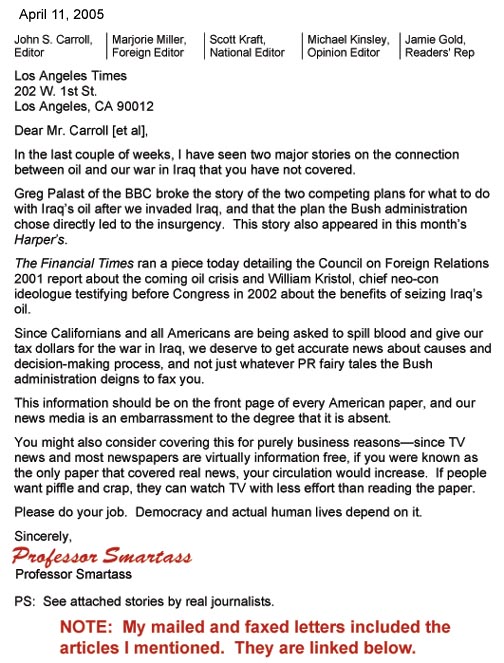
As I mentioned in an earlier letter I mailed to you, I would like to know why you haven't covered the Bush administration's plan to privatize and sell off, essentially steal, Iraq's oil, and the subsequent revision of that policy.

You guys did a great series recently on corruption in reconstruction contracting, which wastes a lot of tax payer dollars, but this privatization scheme probably contributed directly to the insurgency and was why the Bush administration made no plans to pull out and in fact is constructing over a dozen major military installations there.

This is the very heart of the story in Iraq, and Americans need to hear to decide knowledgeably whether to support what our government is doing in our name.

To the degree that the media fell for and printed uncritically the administration's lies about why they went to war in Iraq, you have an obligation to print the real story.

Professor Smartass


__________________________________________

On Apr 19, 2005, at 4:08 PM, Carroll, John - LA Times wrote:

Thanks for the thoughts. I attended the Murdoch talk in Washington and found it interesting. As for our "info-tainment" strategy, I'm not sure what you're talking about. The front of our paper is packed with serious news from all over the world. Calendar does cover entertainment, but in a sophisticated way -- could you imagine a paper based in Los Angeles not doing so? Regarding our fear of scaring away advertisers: We just lost GM because of a Dan Neil column, which we have no intention of correcting or retracting. And no, we don't care about Rush Limbaugh. I agree with your general sentiments about what a newspaper should do, but I believe the L.A. Times is doing them as well as any paper in the country. Yours truly, John Carroll


[Carroll, John - LA Times]


-----Original Message-----

From: Professor Smartass
Sent: Thursday, April 14, 2005 10:19 AM
To: John.Carroll@latimes.com
Subject: Rupert Murdoch on why newspapers are dying (not why you think)

Rupert Murdoch says 18-34 year olds don't find the news media trustworthy OR entertaining, which means you are not only failing at your reason for existence, providing news, but also at your misguided info-tainment strategy.

Two of the successful British internet news sources he mentions, the BBC and the Guardian, differ markedly from their American counterparts in reporting the news regardless of whose ox is gored in the case of the BBC, and printing opinion pieces that are factual, written by the real players (not think tank PR hacks) and question the essence of the policy of those in power.

Real news and real, reasoned dissent.

I would buy a newspaper for that, and trust that I would hear about what's on Bush's iPod and what kind of bikini wax Arnold Schwarzenegger uses on his nipples on Entertainment Tonight.

I know you guys are in a bind; you don't want to scare away advertisers or get that flood of angry letters from toothless, hillbilly Rush Limbaugh fans and that nasty call from Karl Rove, but timidity makes you bland and bland doesn't sell.

You should make it your goal to get those angry letters and consider them a gauge of your success as long as your story is accurate and serves no interests other than giving the public NEWS they actually need to know for democracy to function.


KEY EXCERPTS:

He said consumers wanted "control over the media, instead of being controlled by it", pointing to the proliferation of website diaries known as "blogs" and message boards.

And newspaper editors simply cannot afford to ignore this, he said, or to look down on readers or ignore what they actually wanted.

He said consumers between the ages of 18-34 were increasingly using the web as their medium of choice for news and neglected more traditional media.

Young people's attitudes towards newspapers were "especially alarming", he said. "Only 9% describe us as trustworthy, a scant 8% find us useful, and only 4% of respondents think we're entertaining."

He described the shift in attitudes as "a revolution in the way young people are accessing news".

"They don't want to rely on the morning paper for their up-to-date information. They don't want to rely on a God-like figure from above to tell them what's important. And to carry the religion analogy a bit further, they certainly don't want news presented as gospel."

Mr Murdoch, who recently held a summit with his newspaper bosses about forging a new internet strategy, said the industry had "sat by and watched" as circulations had fallen over the past 40 years, complacent because of its historic monopoly on the news business.

A rise in population had masked a relative decline in the TV age, he said, while in the 1990s profitability had held up in spite of circulations falling, further lulling the industry into a false sense of security.

"But those days are gone," he warned. "The trends are against us...so unless we awaken to these changes, which are quite different to those of five or six years ago, we will, as an industry, be relegated to the status of also-rans."

Now, however, the Sun is, along with the Guardian and the BBC, one of the top 10 news websites in the UK but the online operations of the Times and Telegraph, which have not received the same investment, are not ranked in the top tier.

FULL TEXT:

http://media.guardian.co.uk/site/story/0,14173,1459697,00.html


Tuesday, April 19, 2005

PROBLEM: public attention deficit vs. corporate terminator

A serious problem with making any lasting reform is that it is difficult to get the public to pay attention for more than a couple of years to trying to fix a problem, and once fixed after a while they forget the problem that required the solution in the first place--like the followers of the right wing who have forgotten why we needed the New Deal or even unions.

The good side of this is when a society goes off the deep end religiously like Iran now or England under Cromwell, or politically like Stalinist Russia or China during the Cultural Revolution. Most people get tired of "the cause," it's requirements for zeal and sacrifice of liberty or other things.

The downside of this is that we face opponents, corporations, that are designed to accumulate money and power irrespective of the people who tend the "machine." If someone loses interest, they are replaced. The goal is constant, the people change. They are the Terminator, and money and power is Sarah Connor (the rest of us are the extras that get shot along the way).

Democracy is the opposite. We have roughly the same people to work with for long periods of time, but absent some catastrophe, those people don't act together, and even when they do, they dribble away and drift off to other things over time, collecting Hummel figurines or watching Croatian yard darts on ESPN.

It's like we're all holding a door shut, and the terminator is relentlessly ramming against it. When a certain number wander from holding the door, he busts in, kills who he wants, and makes a mess of everything else. We curse, get together, and try to make a new room with a new door we can stand against--until we lose interest.

Right now, the terminators are break dancing in our family room.

In real life, this is the cycle of robber barons and reform.

This wastes a hell of a lot of time, energy, and money that could be used for real progress instead of fighting these same battles over and over again.

What I want to know is how we can build a door we don't have to stand against.

How can we reshape our political structure so that it is as single-mindedly focused on the broader public good (the way corporations are on ass-raping us) and can't be over-whelmed or hijacked during periods of relative political apathy.

I think when we get to the end of this Buzi push to pull us back to feudalism, we will see a period of FDR-like idealism...and then the forgetting will start and the terminator will start ramming the door.

When we get a chance to clean up, this should be part of what we do.

Friday, April 01, 2005

Serious exchange on Bush Butler story

Re: Bush Butler apology
by: mahlonriggs
04/01/05 10:15 pm
Msg: 5700 of 5731

I would remind you that John Effing Kerry is also a Skull and Bones member. Be careful what you believe, it might bite you on your ass.

Posted as a reply to: Msg 5678 by Professor Smartass

_________________________________

Re: Bush Butler skull/bones butt buddy
by: Professor Smartass
04/02/05 02:24 am
Msg: 5733 of 5733

Kerry was a far from perfect candidate, and it doesn't speak well for our democracy when our choice of candidates run in the same incestuous circles of privilege.

On the other hand, Kerry didn't base his candidacy on homophobia and ostentatious religiousity, so even if the gay aspect of Skull & Bones initiation is true (and most fraternity initiations have strong homo-erotic undertones in any case), nor was he trying to establish the kind of cult of personality that requires people to think he is perfect when he is not. He was running for elected-office as the first among peers, not as self-appointed god-king.

If Bush was a good president, I wouldn't care if he was buggered in a coffin, didn't show up for all his air guard duty, or snorted coke until he was 40. I wouldn't care if he was gay or what he did in his personal life in office.

But the habit of focusing on these things seems to only matter when the candidate is a Democrat (or even an insufficiently conservative Republican).

If you spent the eight years Clinton was in office analyzing his job performance as closely as you did his penis, you might have figured out which of his policies made your life more difficult and which made it easier. Did welfare reform work? Deregulating the media? Clinton's approach globalization? Those are all things that I thnk he did less than ideal work on, and where conservatives who make less than $250K a year should be concerned about their effects too. But instead, you focused on his dick.

So I doubt that you really know if President Bush is helping or hurting you either. You just know that he likes to stand in front of the flag, and mouth allegiance to Christian and Democratic values, and you think he's actually acting on those values because the network and talk radio hosts that get faxed his talking points everyday say he is doing a wonderful job.

It doesn't matter if Bush or Kerry took it up the ass in college because we all are right now. The difference between you and me is, I know it, and you think it's a nasty case of hemorrhoids, but you can't be sure because you don't have health insurance and you don't get overtime pay any more, so you can't go to the doctor to find out.

But it all must be the fault of people like Kerry and Howard Dean.

Posted as a reply to: Msg 5700 by mahlonriggs

Retired Bush valet: W has never wiped own ass


(AP) Thrallport, Maine--Alan Puckerthorn, recently retired lifelong valet of President George W. Bush is surprised that the public thinks of his former master as a "regular guy."


"I served Master Junior from the time he was out of his nappies until my arthritis made it difficult for me to dress and wipe him everyday," Puckerthorn said. "I doubt that he could survive more than a few hours or even minutes without servants to attend to his needs."

Remarkably, he claims the president has never even wiped himself after defecating. "Never. A gentleman does not touch feces even with toilet paper." In fact, toilet paper has never touched Bush's posterior. "His mother insisted we cleanse his anus with natural sponges soaked in mineral water, and then blow on it until it dried."

Puckerthorn didn't consider this duty a hardship until he had to accompany Bush to his one year of public education in fourth grade. "The other children would mock the master viciously when they saw me servicing his rectal hygiene needs. Being a child of privilege this did't hurt his pride any, but it did annoy him." He went on to say that Bush had him beat several of the boys that mocked him. "One must learn to respect their social superiors, and a good drubbing did the trick for most." One boy persisted in teasing Bush though, so Puckerthorn was forced to take the matter to the elder Bush, who used his CIA connection to have the child sold into slavery.

The following year, Bush returned to the safety of Nancy Phillips Academy, an elite finishing school for girls, where, like all the other students, he had not one but two servants, his valet, and another to do his homework.

As his personal manservant, Puckerthorn probably knew more about his master's dreams and ambitions than Bush's parents. "Even before he went to college, I knew Master Junior wanted to be a cheerleader--he slept in the uniform pom-poms and all from the time he was eight. He would fuss so when I tried to dress him for school. His proudest moment was when he made the squad at Yale."

College posed a different set of challenges for the future president's valet. When Bush wished to join Skull & Bones, it was Puckerthorn who had to endure the initiation. "Although I'm British, I didn't enjoyed being buggered in a coffin by someone else's gentleman's gentleman, I can assure you."

When asked how the president will survive without him, Puckerthorn demured. "I've signed a confidentiality agreement that forbids me to give the details, but I believe the duty has fallen to a pasty, pudgy senior staffer. He looks like that unfortunate fat fellow in Deliverance, only not so manly. I knew that it was time to retire when I came in one morning and found him helping the master with his pants."

With the utmost of discretion, Puckerthorn refused to comment on the President's drug use, military service, sexual orientation, literacy, sanity, or mental competence. "One doesn't air the master's dirty laundry in public," he said. "At least not until you have thoroughly scrubbed out the skidmarks."


Tuesday, March 29, 2005

BBC's Greg Palast gives me a message for LA Times editor on Arnold/Enron news blackout

On Mar 19, 2005, at 10:57 PM Professor Smartass wrote:

Greg,

I recently wrote a letter to the LA Times asking why they haven't been more aggressive in covering Arnold's relationship to Enron and the other energy scammers, and attached the project censored coverage of your story. The editor disputed some of the basic facts about Cruz Bustamante even filing a lawsuit, and Arnold having the ability to make it go away.

You can see the LA Times letter and my original letter at http://professorsmartass.blogspot.com/

-- Professor Smartass


______________________________________


From: contact@gregpalast.com

Subject: Re: LA Times disputes Arnold/Enron story
Date: March 29, 2005 12:54:51 PM PST

Hi Professor Smartass,
Greg has written a response which he would you to post or sent to this LA Times guy.
Thanks for making us aware of it.
Kindest regards,
LENI

Here's Greg's comment:


The LA Times editor misreads my exposé on your governor's undermining of the legal action against Enron and other power pirates (or, typical of editors, he commented without reading it).

I'm not surprised. This is a highly complex matter involving regulatory financial accounting and the nexus of regulatory and tort law. It is not the expertise one normally finds in a typical newsroom where almost all matter printed comes from simplified press releases and official statements.

While best known for my TV and popular writings, I am, in another life, an expert on electricity finances and law, author of a seminal work in the area, Democracy and Regulation, introduced by California Public Utilities Commissioner Carl Wood, based on my lectures at the Department of Applied Economics at Cambridge University, England, and the University of Sao Paolo.

The Times editor says his reporters have reviewed much energy-related "stuff" -- and could not find these stories. Indeed, the Times missed the entire Enron story until they could re-print the discoveries of the Wall Street Journal.

I sympathize with the Times limitations in this area; which is why it may be unfair that my team won a journalism award for this story from California State University and not the Times.

As one newspaper wrote in an embarrassingly glowing profile of my reporting, "Palast's ability to make sense of stacks of dense financial data earned him a reputation for doggedness (he holds an MBA from the University of Chicago)."

It was in the LA Times.

Greg Palast
Author, "The Best Democracy Money Can Buy." View Palast's reports for BBC TV at www.GregPalast.com


Wednesday, March 23, 2005

final rounds of Arnold/Enron debate with LA Times editor

David.Lauter@latimes.com
RE: Your defense of Arnold/Enron coverage
Date: March 21, 2005 3:14:50 PM PST

Re Bustamante's suit: He sued as an individual, not on behalf of the state, so there's not much that Schwarzenegger could do to settle the case, whether he wants to or not. (There also may not be much to come of the suit since it's not on behalf of the state.) Lockyer has a number of proceedings in which he's been pursuing the energy companies and has actually gotten some large settlements. No one's likely to get much money out of Enron since it's bankrupt.

Re the broader issue: You can only connect the dots, as you put it, if there's actual evidence. We've had a number of reporters scrub through all sorts of energy-related stuff several times, and we've published what we thought was provable.


_____________________________________________

Professor Smartass
Re: Your defense of Arnold/Enron coverage
Date: March 21, 2005 5:12:16 PM PST

Enron was just one of the named defendants in the suit. I talked to Bustamante's office today, and they said the suits are still in play. It sounds like you aren't too familiar with them, so I'm attaching the original complaints.

Enron was just one of the named defendants in the suit. I talked to Bustamante's office today, and they said the suits are still in play. It sounds like you aren't too familiar with them, so I'm attaching the original complaints.

_____________________________________________

David.Lauter@latimes.com
RE: Your defense of Arnold/Enron coverage
Date: March 21, 2005 5:39:04 PM PST

Thanks. I am familiar with the suits.


Schiavo Brain Dead-- New England Journal of Medicine

This is really all you need to know about the case: her EEG is flat. That's when doctors pull the plug every day.

I can see why many on the right wouldn't want the lack of higher brain function to be the legal standard of death. Legally, most of them would never have been alive in the first place.

Of course the doctors who peer review the New England Journal of Medicine don't know as much about this as Sean Hannity, Pat Robertson, or George W. Bush, a C student business major.

Somebody offered the husband a million dollars to leave her plugged in and he should have taken it. It's just an empty husk of a body, and she isn't suffering. If it makes her family happy to keep it as a memento, let them have it.

KEY EXCERPTS:
...she exhibited no evidence of higher cortical function. Computed tomographic scans of her brain eventually showed severe atrophy of her cerebral hemispheres, and her electroencephalograms have been flat, indicating no functional activity of the cerebral cortex. Her neurologic examinations have been indicative of a persistent vegetative state, which includes periods of wakefulness alternating with sleep, some reflexive responses to light and noise, and some basic gag and swallowing responses, but no signs of emotion, willful activity, or cognition.

There is no evidence that Ms. Schiavo is suffering, since the usual definition of this term requires conscious awareness that is impossible in the absence of cortical activity. There have been only a few reported cases in which minimal cognitive and motor functions were restored three months or more after the diagnosis of a persistent vegetative state due to hypoxic–ischemic encephalopathy; in none of these cases was there the sort of objective evidence of severe cortical damage that is present in this case, nor was the period of disability so long.
FULL TEXT:
http://content.nejm.org/cgi/reprint/NEJMp058062v1.pdf

Monday, March 21, 2005

Arguing with LA Times editor about Arnold/Enron story


March 21, 2005

David Lauter
Deputy Editor/Daily
Los Angeles Times
202 W. 1st St.
Los Angeles, CA 90012

Dear Mr. Lauter,

Thank you for your quick response.

Since you are a professional journalist, I would expect you would know more about this stuff than I would.


But I was unclear on a couple of things from your response. By saying that it is the attorney general’s prerogative to file lawsuits on behalf of the state, does that mean that there is no suit filed by Cruz Bustamante on behalf of utility customers, as covered by the LA Times on page A21, May 3, 2001? To your credit, you did cover that story, but it was buried on page A21, even though the blackouts were front page news for those of us affected by it. I was giving a college final when a blackout occurred and had to decide between canceling it or having my students huddle under one dim emergency light to finish their essays.

You said you covered this issue prominently, but a search of the archives for Schwarzenegger and Ken Lay or Kenneth Lay turned up a handful of incidental mentions in campaign notebook articles, usually when another candidate or protestor mentioned it, and to their credit, in the columns of Steve Lopez and Patt Morrison.

Further, your Jun 30, 2004 story on page C1 seems to confirm what Greg Palast of the BBC reported the summer before: that Arnold would support the weaker FERC settlement rather than the civil suit filed by Bustamante. The article could have connected the dots to explain why a governor so fixated on slashing our budget wouldn’t be interested in recouping as much as possibly of money stolen from us.

To the Times credit, you have covered Arnold’s push to further deregulate electricity, but again, this was buried in the California section of the paper even though the consequences, further rate hikes and blackouts, would be front page news to most Californians. A scan of recent Arnold front page stories includes his visit to the La Conchita landslide, his proposal for a low budget bridge in San Francisco, and his proposals regarding Indian gaming. Are these stories really more important than our governor trying to help the criminals who screwed us out of billions of dollars and who turned out our lights?

You are right that the meeting with Ken Lay by itself might not mean much, but Arnold got substantial aid from President Bush, not the least of which was advice from Karl Rove, staff loaned from Jeb Bush, and a visit from the President to Gray Davis to say he WOULD NOT intervene to cap electricity prices. At the time, Ken Lay was still the lifetime top donor to George W. Bush (he may still be). It’s not exactly a conspiracy theory to connect dots that big, and if the press was taking it’s watchdog function seriously, Arnold should have at least had to give a good explanation why all those things lined up in his favor without this being racketeering before the election.

You did this kind of work on Arnold’s sexual harassment problems. You didn’t just mention a case as it came up, but did the research to connect the dots. That’s all I’m asking. Connect the dots on the front page of the LA Times far enough before Arnold runs for re-election that information becomes part of the public debate.

Given that television news has become a embarrassment focused on celebrities and murder cases, and the free ride Arnold gets on right wing talk radio, where he is fawned over and unlikely to get a tough question, you have an even greater obligation to give the voters of California the news they need to make an informed decision because they aren’t getting it from any other local media.


Friday, March 18, 2005

Iraq's oil: Tony Soprano vs. Fredo

This is just weird, but it's Greg Palast, and he has proved pretty reliable in the past.

Apparently, the oil companies OPPOSED Bush's plan to privatize Iraq's oil because it could undermine OPEC and lead to a collapse in oil prices. Bush began to immediately implement his plan to privatize and sell off Iraq's oil wealth anyway, a move that was accurately interpreted by Iraqis and helped ignite the insurgency.

According to this, they are moving toward something closer to what the oil companies wanted, which would lead to more stability in Iraq.

The problem I have with this is if the big oil companies aren't really behind Bush, who is? Is the military industrial complex so big it can ignore real world power houses like oil? This seems like an episode of the Sopranos, when a more strategic thinking boss like Tony (the oil industry in this case) is somehow outflanked by by a stupid, hot-headed cousin (Bush). On the Sopranos, this would happen to Tony because his twinges of conscience cause him to hesitate and give his Fredos room to screw him.

Unlike Tony Soprano though, corporations have no soul that would explain their leniency toward a Fredo messing with their garbage routes. As a former Shell exec says in this story, "International oil companies, without exception, are very pragmatic commercial organizations. They don't have a theology."

It seems like there's a piece of this story still missing, but the pieces that are here are troubling enough. A couple of rich guys meet behind close doors to make policies that will affect not just our lives, but a big chunk of the Muslim world, and indirectly, the whole world, and regular people's votes and voices seemed to have NO place at the table whatsoever. That has to change.

As the world runs out of oil, which is finally being mentioned openly in Congress, the oil issue will grow in importance, and the more it is done in private, the more democracy is neglected and starved to death here.


KEY EXCERPTS:
Mr Aljibury, once Ronald Reagan's "back-channel" to Saddam, claims that plans to sell off Iraq's oil, pushed by the US-installed Governing Council in 2003, helped instigate the insurgency and attacks on US and British occupying forces.

"Insurgents used this, saying, 'Look, you're losing your country, you're losing your resources to a bunch of wealthy billionaires who want to take you over and make your life miserable,'" said Mr Aljibury from his home near San Francisco.

"We saw an increase in the bombing of oil facilities, pipelines, built on the premise that privatisation is coming."

***

Questioned by Newsnight, Ms Jaffe said the oil industry prefers state control of Iraq's oil over a sell-off because it fears a repeat of Russia's energy privatisation. In the wake of the collapse of the Soviet Union, US oil companies were barred from bidding for the reserves.

Ms Jaffe says US oil companies are not warm to any plan that would undermine Opec and the current high oil price: "I'm not sure that if I'm the chair of an American company, and you put me on a lie detector test, I would say high oil prices are bad for me or my company."

The former Shell oil boss agrees. In Houston, he told Newsnight: "Many neo conservatives are people who have certain ideological beliefs about markets, about democracy, about this, that and the other. International oil companies, without exception, are very pragmatic commercial organizations. They don't have a theology."

FULL TEXT:
BBC NEWS

Secret US plans for Iraq's oil
By Greg Palast
Reporting for Newsnight

The Bush administration made plans for war and for Iraq's oil before the 9/11 attacks, sparking a policy battle between neo-cons and Big Oil, BBC's Newsnight has revealed...

http://news.bbc.co.uk/2/hi/programmes/newsnight/4354269.stm


Saturday, March 12, 2005

CRUCIAL: Help divest from vote rigging companies

The far right take over of America is really all about money for corporate America and financial institutions as the recent bankruptcy bill proved. The religious and cultural right elements are just gestures to get enough votes to give them a fig leaf of legitimacy.

The goal is a one party state where corporate America can write their own rules. If that sounds extreme, consider this treatise by chief GOP strategist Grover Norquist, who runs the weekly meeting where elected Republicans and the right wing press synchronize their message:

"The Democratic Party is Toast"
http://www.washingtonmonthly.com/features/2004/0409.norquist.html

Norquist also famously said, "Bipartisanship is another name for date rape."

Their financial motive, if it wasn't clear enough in the invasion of Iraq and cuts of capital gains and inheritance taxes, should be irrefutable after Bush chose privatizing Social Security as his first big issue after the election. It would give a big chunk of money to Wall Street, and remove the "security" part of Social Security.

If money is the motive, the logical way to fight back is money.

One part of this is demanding that state retirement funds divest from vote rigging companies, as the campaign below needs a minute of your time to do. If you are unfamiliar with how this is done, take a look at this video, and skip up to the segment with Howard Dean, which is about two minutes long. Anybody with an basic knowledge of computers will understand how blatant this scam is after seeing this: http://votergate.tv/movie_links.html

Another way to do this is to pull your money out of large banks and move it to a credit union. These large banks like Bank of America contribute overwhelmingly to GOP to work against your interests. 600,000 people have pulled their money out of B of A since last summer. If enough people do this, it will put a crimp in the money they have to cause trouble with. For a further explanation, see this:

http://www.scoop.co.nz/stories/HL0407/S00040.htm


Protests are good, but they aren't as effective when the people we are protesting own the networks and simply ignore the largest protests in the history of the world, as happened before the Iraq War. They can't ignore an empty pocket though.

KEY EXCERPTS:


• Go to www.velvetrevolution.us/campaigns/dv4d/ and fill out the form to send letters to all nine companies with one click

• Make a generous donation to VR at www.velvetrevolution.us/donate.php to support this massive effort

• Send a letter to Congress telling them that you want paper ballots, open software and non-partisan election officials at www.velvetrevolution.us

• Spread the word about VR and the campaign by telling your friends, posting on the blogs, writing letters to the editor and speaking out.

FULL TEXT:

Begin forwarded message:

From: "Andy Stephenson"
Date: March 9, 2005 9:43:09 PM PST
Subject: Please Support the Velvet Revolution!


Hello, I am writing to ask for your strong support on an electoral reform issue that can make a real difference – the Divestiture for Democracy campaign initiated this week by www.velvetrevolution.us. In short, after two months of hard work, VR, with my active assistance, sent letters to the nine major vote machine companies (Diebold, ES&S, Sequoia, MicroVote, TriadGSI, HartInterCivic, Danaher-Guardian, UniLect, and Advanced Voting Solutions) asking that they voluntarily agree to have voter-verified paper ballots for all votes cast, open software and hardware that is independently analyzed, no networking, no staff involvement in partisan elections, polices for release of requested documents, and other steps designed to make election results trusted once again. We have given these companies 60 days to state that they will take these steps before their machines are used in another election.

As many of you know, several bills are pending in Congress to require these same things. Moreover, Representative John Conyers just strongly endorsed this campaign. However, we should not have to wait as companies that have the ability to make such changes on their own delay doing so while seeking contracts paid for with your tax dollars. These companies have an obligation to act now.

I believe that a concerted effort over the next two months by millions of people who are concerned about democracy could put enough pressure on these companies to get these needed electoral changes. Therefore, I am asking you to do the following:

• Go to www.velvetrevolution.us/campaigns/dv4d/ and fill out the form to send letters to all nine companies with one click

• Make a generous donation to VR at www.velvetrevolution.us/donate.php to support this massive effort

• Send a letter to Congress telling them that you want paper ballots, open software and non-partisan election officials at www.velvetrevolution.us

• Spread the word about VR and the campaign by telling your friends, posting on the blogs, writing letters to the editor and speaking out.

Of course, we may not be successful within 60 days. If not, we will go to the next phase of the campaign – divestiture and boycott to put these companies out of business forever.

Right now, however, you have my call to action. Please act today because together, we can make a difference!!

Thank so much,

Andy Stephenson
Special Advisor,
VelvetRevolution.us

Sunday, March 06, 2005

Who slept with the GOP Man Ho?


It's not a sin if it isn't in the press...

How many right wing pundits got taxpayer money? White House won't give docs to find out

I remember hearing Rush Limbaugh say years ago that the radio was flooded with right wingers because they won in the marketplace of ideas and in the market for listeners. Of course he left out a couple of things like Reagan repealing the Fairness Doctrine that required stations to provide some time for opposing opinions or what Bill Clinton himself now admits was a huge mistake, easing the rules on media consolidation, so a handful of companies could own nearly all the media and use the airwaves to promote the ideas of the party that will do them more favors and be silent about any of their corruption and private affairs.

And Rush didn't mention that at least some of these pundits were being paid by the Bushies to sell particularly parts of their policy and pretend like it's their own idea, which is illegal, covert propaganda. I'd like to know who all is getting this money, but we can't because the Bushies consistently violate the Freedom of Information Act and only comply with it when they think it won't harm them politically.

This is what they are doing for people who are on message. Reporters who drift too far from the pro-Bush ranch can be hounded out of their jobs like Dan Rather and his producers. Those who don't toe the line in Iraq get it a bit worse, but I'll send something on that later.

KEY EXCERPTS:

At press time, the White House had not responded to the request by a couple dozen high-profile House Democrats for information on all PR and advertising contracts with government agencies.

The request cited "secret publicity campaigns to promote administration priorities" including an investigation that "revealed that the Department of Education paid a conservative commentator [Armstrong Williams, though the letter did not name him] to support the No Child Left Behind Act in television and radio appearances," plus another contract with a commentator unearthed following the Williams revelation.

It also cited Government Accountability Office conclusions that video news releases issued by Health and Human Services and the Office of National Drug Control Policy violated anti-propaganda rules, though the Justice Department concluded differently.

FULL TEXT:

White House Mum on PR Contracts
By John Eggerton -- Broadcasting & Cable, 3/4/2005 5:35:00 PM

http://www.broadcastingcable.com/article/CA508851.html?display=Breaking%2BNews&referral=SUPP
w w w . b r o a d c a s t i n g c a b l e . c o m

Friday, March 04, 2005

How close is the president to the White House male prostitute?

Did Bush use the services of this male prostitute that he
had planted to lob softball questions in press conferences?