Showing posts with label peak oil. Show all posts

Friday, May 09, 2008

US Gov't Peak Oil Report: we need to kill big oil before it kills us

I stumbled across this on wikipedia looking for something else on Peak Oil. I keep an eye out for oil stories, but this one slipped by me at the time.

Key findings: Peak oil will definitely happen if it hasn't already, and waiting until world oil production peaks before starting a crash program leaves the world with a major gas & diesel deficit for over 20 years. Since this report was done for the Bush admin, their policies of encouraging mass consumption & oil wars to maximize big oil profits are epically criminal.

This is just a reminder that we need to do more this November than kick out oil company stooges Bush & Cheney. We need to disconnect our government from energy industries that base their profits on creating scarcity, and therefore squeezing the economic life out of all but the very wealthiest of us.

Renewable energy is antithetical to the interests of those businesses and individuals. While switching to renewables will create jobs in the short term, once the hardware is in place, the ''fuel'' going into solar and wind is free, and the more that are built, the lower the price of the energy they produce. You only have to compare this to how our transportation economy works. Toyota, GM, and Daimler Benz are not the most profitable corporations in the history of the world, the companies that extract and process the fuel that go in their cars are. Renewable energy wipes out that most profitable sector, and replaces it with something more akin to making houses, cars,and refrigerators: profitable but not masters-of-the-universe, power-of life-and death-over-the-world profitable.

So long as oil companies and energy speculators have ANY place at the table, the rest of us will suffer.

Our government must do to big oil and energy traders what a farmer does to a bull or hog that gets too troublesome: get the sheepshears, snip off their balls, and feed them to the dogs.
KEY EXCERPTS:

The study envisions three scenarios for dealing with a peak oil reality: scenario one involves action not taken until peaking occurs, and scenarios two and three deal with action taken ten and twenty years prior thereto. The conclusions follow:
  • Waiting until world oil production peaks before taking crash program action leaves the world with a significant liquid fuel deficit for more than two decades.

  • Initiating a mitigation crash program 10 years before world oil peaking helps considerably but still leaves a liquid fuels shortfall roughly a decade after the time that oil would have peaked.

  • Initiating a mitigation crash program 20 years before peaking appears to offer the possibility of avoiding a world liquid fuels shortfall for the forecast period.
FULL TEXT
FULL REPORT IN HTML

FOLLOW UP ON COST TO FIX

OIL THEFT MOTIVE FOR IRAQ WAR RESOURCES


Tuesday, February 21, 2006

PAT BUCHANAN nuclear math: 10,000 US + 200 Israeli nukes= no Iran threat

In 1992, I listened to Pat Buchanan's speech to the GOP convention as I drove from LA to Portland, and he scared the shit out of me. He came close to calling for an open civil war between conservatives and the rest of us. Fortunately, Papa Bush was embarassed by the excess and lost anyway.

Buchanan has not changed, but the Republicans have moved so far right that he has more in common with the left, largely because he refuses to ignore what he knows about history and math for the sake of agreeing the party.

The basic math on Iran is roughly the same as it was on Iraq:
  • We have 10,000 nuclear warheads

  • Israel has 200

  • Iran has none (maybe a handful in a few years to a decade)

  • If Iran uses one on us or Israel, either of us could nuke Iran out of existence and still have plenty to spare.

Back in the Cold War, neither we nor the Soviets launched our nukes because of Mutually Assured Destruction (MAD). It seems hard to believe a smaller country would commit suicide, knowing that at best they injured us, but couldn't take us with them. This should be called a corollary of MAD: OSH-OSAD (One Side Hurt-One Side Assured Destruction).

We have the most powerful military on earth, but are continually being persuaded that some flea on our ass is going to eat us alive. imagine you had a neighbor who collected machine guns and occasionally shot the other neighbors dogs. Would you ever steal his newspaper off the driveway? Or sleep with his wife? Or pick a fight with him?

If you prefer we skip this war, sign this petition that Howard Zinn, Harold Pinter, and George Galloway have already put their names on:

http://stopwaroniran.org/statement.shtml

KEY EXCERPTS:


Churchill, Hitler, and Newt

By Patrick J. Buchanan

02/20/06 "WND"

But are the comparisons of Ahmadinejad with Hitler and Iran with the Third Reich, let alone Newt with Churchill, instructive? Or are they ludicrous? Again, a few facts.

In 1942, Hitler's armies dominated Europe from the Pyrenees to the Urals. Ahmadinejad is the president of a nation whose air and naval forces would be toasted in hours by the United States. Iran has missiles that can hit Israel, but no nuclear warheads. Israel could put scores of atom bombs on Iran. The United States, without losing a plane, could make the country uninhabitable with one B-2 flyover and a few MX and Trident missiles.

Why would Ayatollah Khameinei, who has far more power than Ahmadinejad, permit him to ignite a war that could mean the end of their revolution and country? And if we were not intimidated by a USSR with thousands of nuclear warheads targeted on us, why should Ahmadinejad cause Newt to break out in cold sweats at night?

Currently, the "nuclear program" of Iran consists of trying to run uranium hexafluoride gas through a few centrifuges. There is no hard evidence Iran is within three years of producing enough highly enriched uranium for one bomb.

FULL TEXT:

http://www.informationclearinghouse.info/article11991.htm


Monday, July 04, 2005

the reality driving our foreign policy, wars, and the coming draft: OIL depletion


The article below is an excellent summary and collection of links on the biggest story of our lives that few people know about.

Back in 1956, an oil company geologist made a simple prediction: that once discovery of oil declined, production would decline a few decades later--you can't pump what isn't there. He said the United States production would begin to decline in the mid 70s, and was right. He predicted the world peak would be in the first decade of the 21st century, oddly right around the time we decided we need to invade the second biggest oil producing country, right next to the biggest.

The last parts of the world that will be drained are the Caspian Sea Basin right about the Iran and Iraq, but even that pales compared to the Persian Gulf countries themselves.

Our politicians aren't talking about this because they have already decided what they are going to do about it--militarily occupy and control those countries that will have oil the longest.

If the American people knew about this, they might reasonably ask their government to skip the wars and get right to replacing oil, which we will have to do eventually anyway, and which will probably cost less than what we will spend in Iraq and later Iran.

Unfortunately, as we are seeing now, even this flawed policy is only for the benefits of the oil companies, not the American people.

Even when it comes to replacement technologies, the government is focusing on coal & nuclear, energy sources that can be monopolized the way oil is now.

In the short term, the real alternative is small scale wind & solar generation on individual houses and businesses, connected like an energy internet, so you put energy in as well as take it out, and you could even end up coming out ahead on the deal at the end of the month.

Our cars could be modified to run on biofuels, which we could produce with about 6% of our farm land. But again, if someone tried to drive the price up too high, it's easy to see how to control the price: someone else will grow more corn and make more fuel and sell it for less.

I'm not sure if we can get our government to do this, given the stranglehold that big business has on Washington, but if you own a house or a farm, you should start googling around and see if photovoltaics, solar thermal, or a windmill will work on your site.


http://www.lapostcarbon.org/
Los Angeles Post Carbon
LAPostCarbon.org


Reposted with permission from www.energybulletin.net/primer.php

Peak oil primer and links


What is Peak Oil?

Peak Oil is the simplest label for the problem of energy resource depletion, or more specifically, the peak in global oil production. Oil is a finite, non-renewable resource, one that has powered phenomenal economic and population growth over the last century and a half. The rate of oil 'production,' meaning extraction & refining (currently about 83 million barrels/day), has grown in most years over the last century, but once we go through the halfway point of all reserves, production becomes ever more likely to decline, hence 'peak'. Peak Oil means not 'running out of oil', but 'running out of cheap oil'. For societies leveraged on ever increasing amounts of cheap oil, the consequences may be dire. Without significant successful cultural reform, economic and social decline seems inevitable.

Why does oil peak? Why doesn't it suddenly run out?

For obvious reasons, people have extracted the easy-to-reach, cheap oil first. The oil pumped first was on land, near the surface, under pressure and light and 'sweet' and easy to refine into gasoline. The remaining oil, sometimes off shore, far from markets, in smaller fields, or of lesser quality, will take ever more money and energy to extract and refine. The rate of extraction will drop. Furthermore, all oil fields eventually reach a point where they become economically, and energetically no longer viable. If it takes the energy of a barrel of oil to extract a barrel of oil, then further extraction is pointless.

M. King Hubbert - the first to predict an oil peak
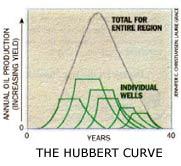
In the 1950s a US geologist working for Shell, M. King Hubbert, noticed that oil discoveries graphed over time, tended to follow a bell shape curve. He posited that the rate of oil production would follow a similar curve, now known as the Hubbert Curve. In 1956 Hubbert predicted that production from the US lower 48 states would peak in 1970. Shell ordered Hubbert not to make his studies public, but the notoriously stubborn Hubbert went ahead and did it anyway. As it turned out, most people inside and outside the industry dismissed Hubbert's predictions. In 1970 US oil producers had never produced as much, and Hubbert's predictions were a fading memory. But Hubbert was right, US continental oil production did peak in 1970/71, although it was not widely recognized for several years and only with the benefit of hindsight.

No oil producing region neatly fits bell shaped curve exactly because production is dependent on various geological, economic and political factors, but the Hubbert Curve remains a powerful predictive tool.

So when will oil peak globally?

For about 30 years the world has been finding less oil than it has been consuming. Discovery of new oil fields peaked in the 1960s. Around 50 oil producing countries have already peaked and now produce less and less oil each year, including the USA and the North Sea. Hubbert's methods, and variations of them, and other methods entirely, have been used to make various projections about the global oil peak, with results ranging from 'already peaked', to the very optimistic 2035. Many of the official figures used to model oil peak such as OPEC figures, oil company data, and the USGS discovery projections can be shown to be very unreliable. Several notable scientists have attempted independent studies, most notably Colin Campbell and the Association for the Study of Peak Oil and Gas (ASPO).


ASPO's latest 2004 model suggests a peak of 'conventional' oil in 2005, and all oil and gas liquids in 2008. Others such as Kenneth Deffeyes and A. M. Samsam Bakhtiari have made similar or even earlier predictions, although precise predictions are difficult as much secrecy shrouds important oil and gas data.

Globally, natural gas is also expected by some to peak within decades, although its affects are more localized due to the added expense of transporting liquefied natural gas (LNG). Both British and North American natural gas may have peaked already.


What does this mean?

Our industrial societies and our financial systems were built on the assumption of constant growth, growth based on ever more readily available cheap fossil fuels. Oil in particular is the most convenient and multi-purposed of these fossil fuels. Oil currently accounts for about 40% of the world's commercial energy, and about 90% of transportation energy. Oil is so important that the peak will have vast implications across the realms of geopolitics, lifestyle, agriculture and economic stability.

Read the rest at:
www.energybulletin.net/primer.php

Thursday, April 21, 2005

In 1999, Dick Cheney said we would start running out of OIL by 2010

This article links to the speech it self. Oddly, that link is dead, but if you go to the wayback archive, you can still get it:

http://web.archive.org/web/20001215051700/http://www.petroleum.co.uk/speeches.htm

It's nice to know that members of the Bush administration can be honest, even if it's with the London Institute of Petroleum not with us.

Cheney did show a sense of humor though: he complained that oil, unlike soapflake companies and other business interests, have little influence over politics.

If you know someone who still believes these guys are building bases around the Caspian Sea [in the former Soviet Union] and invading countries around the Persian Gulf because they are worried about terrorism, whap them over the head with the words of our lizard-like vice president, who rarely come out of his bunker to sun himself, usually when he smells oil.

Far from being out of left field, it echoes predictions in James Baker's report at Rice University, the Council on Foreign Relations, and in fact, any peak oil research. You rarely hear about this in the US press, but the Guardian in the UK had an important story on it today:

http://www.guardian.co.uk/life/feature/story/0,13026,1464050,00.html


KEY EXCERPTS:

Oil is unique in that it is so strategic in nature. We are not talking about soapflakes or leisurewear here. Energy is truly fundamental to the world’s economy. The [first] Gulf War was a reflection of that reality.

By some estimates there will be an average of two per cent annual growth in global oil demand over the years ahead along with conservatively a three per cent natural decline in production from existing reserves. That means by 2010 we will need on the order of an additional fifty million barrels a day. So where is the oil going to come from? Governments and the national oil companies are obviously in control of about ninety per cent of the assets. Oil remains fundamentally a government business. While many regions of the world offer greet oil opportunities, the Middle East with two thirds of the world's oil and the lowest cost, is still where the prize ultimately lies, even though companies are anxious for greater access there, progress continues to be slow.

looking back to the early 1990's, expectations were that significant amounts of the world's new resources would come from such areas as the former Soviet Union and from China. Of course that didn't turn out quite as expected.”

Some of the oil being developed in new areas is obviously very high cost and low margin. Companies that are finding it difficult to create new core areas through exploration are turning to production deals where they can develop reserves that are already known, but where the country doesn’t have the capital or the technology to exploit them. In production deals there is less exploration risk but dealing with above ground political risk and commercial and environmental risk are increasing challenges. These include civil strife, transportation routes, [Afghanistan, Syria, Lebanon] labour issues,[i.e. labor needs to be neutered] fiscal terms, sometimes even US-imposed economic sanctions.[referring to Iraq, Libya, and dealing with Taliban for pipeline in Afghanistan]

In many ways the traditional role of oil companies are changing. Increasingly we are seeing international oil and gas companies concentrating on managing investment, financial, commercial and political risk or above ground risk, while service companies are managing technical, completion and operating risk. Meanwhile, national oil companies are focused on managing their country’s national interest and its resources and in the domestic markets. This is part of the new resource rationalism of the 1990’s. NOC’s may own the resources, but when it is in the national interest to bring in outsiders to help develop them, they do so. Venezuela obviously is a clear example of what I would define as the new resource nationalism.