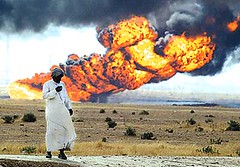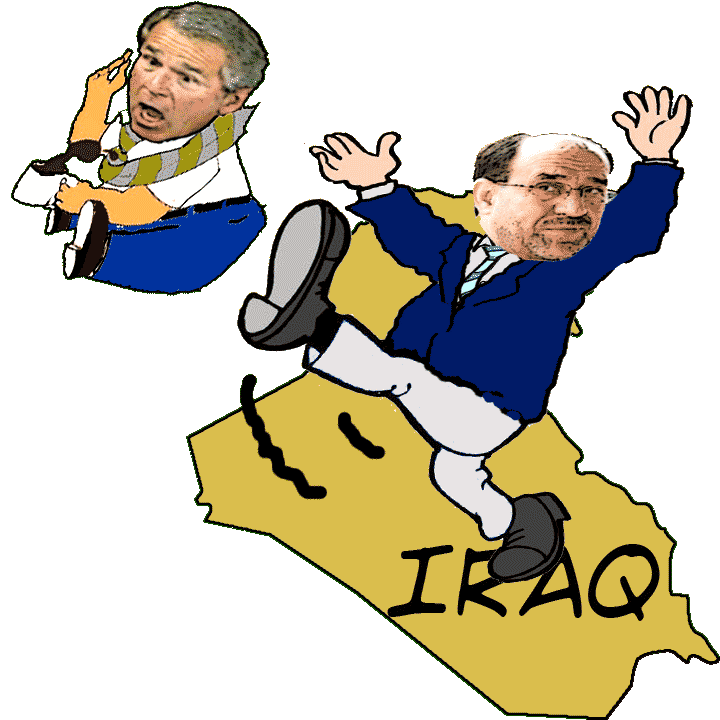
Showing posts with label hands off iraqi oil. Show all posts

Thursday, November 27, 2008

Iraqis democracy has beaten Bush
& represented Americans better than our own Congress


While lately the news has mostly been about nothing and maybe some trivia about the boring establishment types Obama has picked for his cabinet, Bush has quietly been finishing up losing the war in Iraq.

Ironically, he is losing the real agenda, installing a regime obedient to the US and international oil companies, because he succeeded at what he thought was a purely propaganda goal, establishing a democracy.

The cabinet of the Iraqi government has been sufficiently compliant to Bush's wishes, approving a hydrocarbon law that would have given 88% of Iraq's oil income to international oil companies and leaving just 12% for Iraqis. However, the parliament as a whole refused to approve it even after they were offered millions in bribes each by the oil companies.

As a consequence of that law not passing, when Iraqi opened up bidding on some oil concessions recently they set the floor for bids at 49% royalties for Iraqis, which means they will likely get significantly more than that, and closer to what their neighbors with easily accessible oil like theirs get. The closer Iraq's royalties get to their neighbors, the more it looks like oil companies could have gotten to the same place in Iraq without us spending three-quarters of a trillion dollars invading and occupying Iraq, killing a million Iraqis, and wasting the lives of thousands of our troops who thought they enlisted to protect their country not expand oil company profit margins.

Now the cabinet has negotiated a withdrawal treaty with Bush that would pull US troops out of Iraqi cities by this summer, and out of Iraq altogether by 2011. It is unclear whether the Iraqi parliament will pass it since there is tremendous public pressure on them to end the occupation as soon as possible. If this agreement does not pass, a UN resolution allowing US forces to stay in Iraq will expire December 31, making the mere presence of our troops there a war crime, and requiring a quick withdrawal.

Even if the treaty is passed, it will be a crushing defeat for Bush. It allows no permanent bases in Iraq, Iraq may not be used as a base to invade neighboring countries, and US forces may no longer kick in doors in the middle of the night and take Iraqis prisoner indefinitely. Best of all, Bush's Blackwater and other mercenary army will no longer be immune from Iraqi law, which destroys the only argument for continuing to use them since they cost far more than regular US military and are far more hated by Iraqis because they commit atrocities with impunity.

Either way, the Iraqis win, Bush loses, and the Iraqi parliament will have done for America what our own elected representatives have refused to do in spite of overwhelming public support: end the war in Iraq.
KEY EXCERPTS:

This is no sop. It is a vote to end the occupation of Iraq

The total defeat of the US plan to install a supine ally in the Middle East is likely to be confirmed today in Baghdad

Jonathan Steele
guardian.co.uk, Thursday November 27 2008 00.01 GMT

The agreement stipulates that "all US forces shall withdraw from all Iraqi territory no later than December 31 2011". More remarkably, all combat troops will leave Iraqi towns and villages and go back to base by the end of June next year. Pause for a moment and take that in. Six years and three months after the invasion, Iraqi streets will be a US-free zone again.

Iraq will have a veto over all US military operations. A clause added at the last minute after pressure from Iran says that Iraqi land, sea and air may not be used as a launch pad or transit point for attacks on other countries. The Iraqi government eagerly took up the point after US helicopters flew into Syria and attacked a compound there last month, claiming it was a base from which foreign fighters entered Iraq. Iraq joined Syria in protesting against the raid.

Under the withdrawal agreement, no Iraqi can be arrested by US forces except with permission from Iraqi authorities, and every Iraqi who is arrested in these circumstances must be handed to Iraqi forces within 24 hours. The tens of thousands of detainees in US custody must either be released or turned over to the Iraqis immediately. US troops may not enter or search any Iraqi house without an Iraqi judge's warrant, except if they are conducting a joint combat operation with the Iraqi military.

US contractors - the armed mercenaries in their SUVs whom Iraqis hate even more than the American military - will lose their immunity and be subject to Iraqi law, a development that is already prompting many security firms to start pulling out. US troops who rape Iraqi women or commit any other crime while off duty and off base will have to stand trial in Iraqi courts.

***

The deal gives Iraq's national resistance almost everything it fought for. How did Nouri al-Maliki's government achieve it? The main reason is that Iraqi nationalism and the occupation's unpopularity have become overwhelming. Opinion polls have long shown that a majority of Iraqis wanted the occupation to end. They found it humiliating and oppressive. Al-Qaida's infiltration, and the sectarian conflict which its supporters and recruits successfully provoked in 2006 and 2007, distracted many Iraqis for a time. Some saw the US as the lesser enemy. But al-Qaida's power has waned thanks to the Awakening movement of Sunni tribal leaders; and the primary issue, the US intervention, has returned to centre stage. Nationalist sentiment, articulated from the first weeks of the occupation by Sunni insurgents (many of whom later joined the Awakening movement) as well as Moqtada al-Sadr's Shia militia, has spread through the country's ruling elite. This summer Prime Minister Maliki began to realise that he had more to gain by posing as the man who achieved a US withdrawal than by trying to block it. It is a triumph for Iraq.

***

From the American point of view, the main thing the pact does is to allow the US to withdraw with dignity. No hasty Vietnam-style humiliation, but an orderly retreat from an adventure which was illegal, unnecessary, and a disaster from the moment of conception. Like most Iraqis, I am content with that. American neoconservatives will declare victory, as Frederick Kagan, one of the architects of the "surge", did this week. But the fact is that Bush and his ideologues wanted to make Iraq a protectorate and stay indefinitely so as to intimidate Iran and Syria. Now they have been forced to give up, and a newly confident Tehran has been helping its neighbouring Shia-led government in Baghdad to show them the door.

FULL TEXT

Monday, September 29, 2008

Missing from the first debate: honesty about OIL & foreign policy

In the first presidential debate, this little nugget by John McCain caught my attention:

That wasn't just about a problem between Georgia and Russia. It had everything to do with energy.

There's a pipeline that runs from the Caspian through Georgia through Turkey. And, of course, we know that the Russians control other sources of energy into Europe, which they have used from time to time.

John McCain in presidential debate Sep. 26, 2008

You would think there would be nothing noteworthy about talking about how oil effects our foreign policy--except that was the ONLY specific reference to it in the debate apart from both McCain and Obama making very indirect references to "breaking our dependence on foreign oil."

That's a nice thought, but I'd rather hear some specifics like:

  • Did the oil industry prevent us from punishing Saudi Arabia for 9/11? The Joint Congressional Inquiry into 9/11 found that the Saudi government was responsible, but Bush classified that section of the report, and nothing else was ever said about it again.

  • For McCain & Biden: did you vote for the Iraq War because someone quietly convinced you that controlling Iraq's oil would somehow benefit average Americans, or did you know it was only meant to help oil companies?

  • Why haven't any of the candidates addressed the Hydrocarbon Law Bush tried to push on the Iraqis that would have given 88% of their oil profits to American big oil companies, and given those companies a seat on the committee that made decisions on their oil reserves? Don't you think that might have pissed off some Iraqis enough to take a shot at our troops?

  • What do you expect to happen to the price of oil if we attack Iran?

  • Do you plan to try to occupy Iran?

  • Is it a wise foreign policy to kill so many people, making enemies that will last long after the last drop of oil is gone?

  • Why do you talk to us like fucking children about terrorist boogeymen instead of the real geopolitical motives for what we are doing in the Persian Gulf and Caspian Basin: trying to gain control of the last spigots of the world's diminishing oil supplies?

  • Speaking of which, exactly how did you expect Russia to react if we tried to take over their oil trade with Europe and the rest of the world?

  • How do you expect both Russia and China to react if we achieve our goal of controlling all of the Persian Gulf and Caspian Sea oil flow? If we were them, would take it quietly?

  • The cliche about "breaking our dependence foreign oil" implies that our wars in the Middle East are to secure oil to run our economy. However, if that was our motive couldn't we simply do what China is doing in Canada, Venezuela, and the Sudan: buy it with long term contracts?

  • Isn't war to secure oil only necessary if another world power has it and is withholding it, OR if an oil company wants to force terms on the natives that they wouldn't accept without a gun to their heads?
To the extent that those running for the highest elected office in America DON'T talk honestly about this, they are castrating our democracy by withholding what would allow us to make an informed decision about who to vote for, and showing loyalty to a constituency in a smoke-filled room at the country club and not to American citizens as a whole.

Sort of like what happened when they tried to give away $700 billion of our hard-earned tax dollars to the already wealthy.


Monday, September 01, 2008

Iraq's China Oil deal neuters Bush's thuggery for American big oil


Iraq just signed a 22 year oil service contract with China without the profit sharing that American companies have been been demanding with the help of the Bush administration.

This is a stunning setback for the Bush administration in Iraq.

One of the goals of the war was to set up contract's for drilling Iraq's oil on terms American oil companies dictated. The first draft of the Iraqi Hydrocarbon Law, written at the Bush administration's direction by an American consulting firm, Bearing Point, gave 88% of the oil profits for new fields to the oil companies.

In stark contrast, Iraq has just signed an oil service contract with China that includes NO profit sharing, just a set service fee--less generous terms than China got under Saddam.

American companies have signed similar deals, but on short term contracts of one to two years, not 22 like China's, in hopes that Bush would do through coercion what would be impossible through fair negotiations.

This China deal is probably meant as a message to the American oil companies and the Bush administration, who are continuing to pressure the Iraqis for an oil law that gives away most of their oil income, and contracts that do the same.

The message is that no Iraqi government will betray their country by giving their wealth to foreigners, not even with a gun to their head.

This also undercuts the key argument for giving oil companies the bulk of the oil profits, which is that it is not worth the effort unless oil companies get most of the profits. China thinks those billions of dollars of service fees are worth the effort.

By succeeding at his stated but insincere goal of establishing a democracy (Bush once threatened to fire the Iraqi prime minister if the oil law wasn't passed), Bush has frustrated his real one: giving Iraq's oil reserves, the second largest in the world and worth tens of trillions of dollars, to friends at ExxonMobil, Chevron, & BP.

This also shows that the Iraq War had nothing to do with securing access to oil supplies to run our economy. If that had been the goal, Bush would have pushed the oil companies to accept terms the IRAQIS wanted to insure friendly long term relations and access to their oil. Instead, he risked that to put more money in the pockets of his friends.

This is the problem with having a petulant, spoiled, dim-witted rich child for a president. He thinks if he stamps his feet, raises his voice, and slaps some people around, he will get what he wants because of course it always worked on his families butlers and maids.

MORE ON OIL THEFT MOTIVE FOR IRAQ WAR


KEY EXCERPTS:


The 22-year contract is a renegotiated version of a 1997 agreement between China and Iraq under Saddam Hussein. The original contract included production-sharing rights, but under the new contract China will be paid for its services but will not share in profits.

Before 2003, Iraq had oil agreements with China, Russia, Indonesia, India and Vietnam, three of them production sharing. Iraqi officials have said that they are reconsidering the terms of these agreements because of the increased price of oil, a new government and other changes since the fall of Mr. Hussein’s government. Iraq says that the contract with the Russian oil giant Lukoil for one of Iraq’s largest oil fields was canceled by Mr. Hussein.

The government is also negotiating service contracts with ExxonMobil, Shell, Total, BP, Chevron and some smaller oil companies. The length of the agreements was reduced to one year from two after Iraq drew wide criticism for not putting the contracts out for competitive bidding.

The Ahdab oil field represents only a modest fraction of Iraq’s oil wealth — the field is expected to produce 90,000 barrels of oil a day. Iraq’s overall oil production is 2.5 million barrels a day, but the government wants to increase that to 4.5 million a day over the next five years. Mr. Ulum said that the size of the renegotiated deal with China — the previous contract was worth just under $700,000 — could influence the financial terms of future contracts.

FULL TEXT


Thursday, February 28, 2008

al Qaeda in Iraq small & unpopular except in Bush/McCain propaganda


John McCain demonstrated a Bush level of stupidity when he chastised Obama about supposedly not knowing there is "al Qaeda in Iraq."

There is such a thing, but McCain (and a lot of Democrats for that matter) forget to include some important details.

To the extent Iraqis themselves are fighting us, it's for a couple of reasons:

The bottom line is as little as 1% of Iraqis feel safer because we are there and overwhelming majorities want us to leave.

How are we teaching them democracy by ignoring that?


Thursday, January 31, 2008

BIG OIL tries to BRIBE Iraqis to pass OIL THEFT LAW

Each member of parliament is being offered $5 million dollars to vote for the law.

I don't know why the oil companies didn't think of this sooner since it works so well with our Congress.

Bush, Congress, the World Bank, and IMF have all been pressuring Iraq to pass a Hydrocarbon Law that will give up to 88% of income from new oil fields to big oil companies, a deal no other major oil producing country would take without a gun to their head.

Iraqi oil workers, scholars, and former oil ministry bureaucrats all oppose the law, and polls of Iraqis show they want their oil developed by a national oil company NOT foreign oil companies. This is true even in the Kurdish region that has seemed most cooperative with the Bushies.

Even the most venal, self-interested legislator will probably think twice about taking the bribe, if not to avoid betraying their country, to avoid being shot by their countrymen. I would only take it if it included a plane ticket out of the country too.

Even the most corrupt and Bush-compliant Iraqi parliament knows their are limits to what their people will tolerate before they storm the walls of the Green Zone.

Occasionally, when someone reminds a candidate that all the reasons given for the Iraq War, WMD, terrorism, and spreading democracy have turned out to be embarrassing, childish lies, the politician will tell a more grown up lie, that we need to protect our "vital interests" in the region or even bluntly say we need "access" to that oil. However, if the war was just about access, we could have gotten it the same way China is getting it from Iran and Venezuela: with long term contracts. Even if the military presence was part of an effort to secure "access," you would think we would accept any deal the Iraqis found agreeable to preserve the flow of that oil. Instead, we are putting a gun to their heads solely to maximize oil company profits, and increasing the hatred of our presence in the region. Oil company executives were even concerned that without a war in Iraq, when the sanctions came off, Saddam would pump too much oil and drive prices down, so we are effectively fighting a war to pay MORE not less at the pump.

The oil companies push to control Iraq's oil reserves is rarely discussed in American newspapers, and is blacked out from TV news, which makes it all the more important that stories like this is forwarded to anyone who will read it and voted up on the newsranking sites linked below.

FULL TEXT:


American Oil companies offered five million dollars to each Iraqi MP to pass the Oil law

Reported today on Akhbar Alkhaleej newspaper via Road to Iraq

An Iraqi MP preferred to remain anonymous told the newspaper that highly confidential negotiations took place by representatives from American oil companies, offering $5 million to each MP who votes in favor of the Oil and Gas law.

The amount that could be paid to pass the votes do not exceed $150 million dollars in the case of $5 million to each MP, pointing out that the Oil law requires 138 votes to pass, which the Americans want to guarantee in many ways, including vote-buying, intimidation and threats!

Focusing on the heads of parliamentary blocs and influential figures in the parliament to ensure the votes, the Americans guaranteed the Kurdish votes in advance but they are seeking enough votes to pass and approve the law as soon as possible.

Google translation of original Arabic article

MORE IRAQ WAR OIL THEFT MOTIVE SOURCES


Wednesday, October 24, 2007

Iraq War happy ending in sight: Iraqis keep oil, Bush & cronies get nothing

Despite hundreds of thousands of dead, and their country salted with depleted uranium, the Iraqis may yet take control of their democracy and natural resources--IN SPITE of Bush, not because of him.

From before the start of the war, the Bush administration planned to privatize and sell off everything in Iraq to their cronies at bargain basement prices, especially the oil.

The Bushies one mistake is they thought the Iraqis are as stupid as the average Fox News viewer, and would believe whatever hatful of shit propaganda he dished out, and if they didn't, they could scare the Iraqis into obedience by picking up people at random and torturing and raping them at Abu Ghraib.

The Iraqis knew why Bush was there though, and even after Bush vetoed their choice for prime minister and approved his replacement and then threatened him with firing, the Iraqis refused to sign away their oil wealth to Bush's corporate cronies.

If the Iraqis are successful in hanging onto their oil, it might just shave a few years off the hatred Bush has earned for us. But it won't bring back the grandmothers and babies crushed in rubble or the arms burned off a boy in the initial and on-going shock and awe air strikes.
KEY EXCERPTS:

Tomgram: Jack Miles, Baghdad to Bush: You Have 14 Months

By December 31, 2008, according to Foreign Minister Hoshyar Zebari, the government of Iraq intends to have replaced the existing mandate for a multinational security force with a conventional bilateral security agreement with the United States, an agreement of the sort that Washington has with Kuwait, Saudi Arabia, and several other countries in the Middle East. The Security Council has always paired the annual renewal of its mandate for the multinational force with the renewal of a second mandate for the management of Iraqi oil revenues. This happens through the "Development Fund for Iraq," a kind of escrow account set up by the occupying powers after the overthrow of the Saddam Hussein regime and recognized in 2003 by U.N. Security Council Resolution 1483. The oil game will be up if and when Iraq announces that this mandate, too, will be terminated at a date certain in favor of resource-development agreements that -- like the envisioned security agreement -- match those of other states in the region.

The game will be up because, as Antonia Juhasz pointed out last March in a New York Times op-ed, "Whose Oil Is It, Anyway?":

"Iraq's neighbors Iran, Kuwait and Saudi Arabia…. have outlawed foreign control over oil development. They all hire international oil companies as contractors to provide specific services as needed, for a limited duration, and without giving the foreign company any direct interest in the oil produced."

By contrast, the oil legislation now pending in the Iraqi parliament awards foreign oil companies coveted, long-term, 20-35 year contracts of just the sort that neighboring oil-producers have rejected for decades. It also places the Iraqi oil industry under the control of an appointed body that would include representatives of international oil companies as full voting members.

The news that the duly elected government of Iraq is exercising its limited sovereignty to set a date for termination of the American occupation radically undercuts all discussion in Congress or by American presidential candidates of how soon the U.S. occupation of Iraq may "safely" end. Yet if, by the same route, Iraq were to resume full and independent control over the world's third-largest proven oil reserves -- 200 to 300 million barrels of light crude worth as much as $30 trillion at today's prices -- a politically incorrect question might break rudely out of the Internet universe and into the mainstream media world, into, that is, the open: Has the Iraq war been an oil war from the outset?

***
Clearly, some in Washington still think so. Shortly before the collapse of the Iraqi oil legislation effort, Bush's Commerce Department began quietly advertising for an Arabic-speaking legal advisor to help it in "providing technical assistance to Iraq to create a legal and tax environment conducive to domestic and foreign investment in Iraq's key economic sectors, starting with the mineral resources sector." (Read: starting with oil.) As it happens, the job description overlaps heavily with that of the Development Fund for Iraq's existing International Advisory and Monitoring Board, whose responsibility, according to U.N. Security Council Resolution 1483, has been to see to it "that all export sales of petroleum, petroleum products, and natural gas from Iraq…. shall be made consistent with prevailing international marketing best practices." Is the Commerce Department already planning for the demise of this board? Like the super-embassy and the super-bases, this bit of Commerce Department staffing-up bespeaks the urge to continue an invasive American presence in Iraq, including Iraq's energy sector, long after December 31, 2008.

But if the occupation is shut down legally after that date and if Iraqi control over Iraqi oil reverts -- legally, at least -- to something close to pre-war status, that Commerce Department expert may find him or herself playing a less-than-major role in Baghdad. Instead, expect a new role for Iraq's hitherto excluded pool of domestic expertise. The Iraq National Oil Company began operations back in 1961; its legacy includes a skilled work force of trained oil workers. Notable, in fact, among those opposed to the failed oil legislation is the Iraqi Federation of Oil Unions. Its members object to provisions in the legislation that permit the hiring of foreign oil workers rather than Iraqis and -- in classic Bush Administration fashion -- exclude the union from any participation in contract negotiations. The Federation's protests have attracted a letter of support signed by six Nobel Peace Prize laureates.


FULL TEXT


MORE IRAQ OIL THEFT RESOURCES


Sunday, September 16, 2007

UK: Over 100 MPs demand British gov't stop lying about role in Iraq OIL THEFT LAW

To their credit, over 100 members of parliament are calling on the British government to come clean over its involvement in the drafting of Iraq's Hydrocarbon Law that is opposed by the Iraqi oil workers, scholars, five Nobel Laureates, and the Iraqis that happened to have heard what it will do. Here in the US, the number of those in Congress speaking honestly about oil motive can be counted on one hand. Maybe we need a lesson in Democracy from "Old Europe."

Excerpts from the motion by Katy Clark in Parliament:
  • That this House notes that Iraq's economy is heavily dependent on oil and that decisions about the future of Iraq's oil industry will have a major bearing on that country;
  • further notes that the constitution of Iraq states that oil and gas are owned by all the people of Iraq;
  • expresses concern that the British Government, in its involvement in the drafting of Iraq's new oil laws, has sought the views of international oil companies regarding the possible types of contracts that the Iraqi government should offer;
  • believes that decisions on the Iraqi oil industry should be made by the Iraqi people without outside interference;
  • and calls on the Government to disclose to the House all representations it has made in relation to the oil law.

LINK & ROLL OF MPs SUPPORTING

Friday, November 11, 2005

Powell aide says war about OIL so we can't leave

Colin Powell's chief of staff has been speaking out on the workings of the Bush administration, and confirming what critics on the left have been saying about Bush since the beginning: that they have subverted the way our government works, and that the checks and balances which Bush ignores are actually needed for our security.

More importantly though, he openly acknowledges the significance of OIL in the decision-making process to go to war and why policy-makers will not seriously consider a pullout, regardless of their public statements or party affiliation.

This article also recounts what Former Bush Treasury Secretary John O'Neill said about the extent of the oil planning before the war and even before 9/11.

Totally apart from whether we should stay in Iraq or go, it's a sad comment on our democracy that NONE of the real debate is going on in public, not by the rubber stamp republican congress, and not even by the supposed opposition Democrats.


I don't know what good it does, but I'm going to send this to every Democratic senator and bust their balls about lying to us as much as the Republicans do on Iraq.

KEY EXCERPTS:


So Iraq Was About the Oil

By Robert Parry

November 8, 2005


While bemoaning the administration’s incompetence in implementing the war strategy, Wilkerson said the U.S. government now had no choice but to succeed in Iraq or face the necessity of conquering the Middle East within the next 10 years to ensure access to the region’s oil supplies.


“We had a discussion in (the State Department’s Office of) Policy Planning about actually mounting an operation to take the oilfields of the Middle East, internationalize them, put them under some sort of U.N. trusteeship and administer the revenues and the oil accordingly,” Wilkerson said. “That’s how serious we thought about it.


***********************************

Active preparations for war with Iraq were soon underway. Behind the scenes, O’Neill said he watched as the administration refined its plans for how to divvy up Iraq’s oil reserves after the invasion.


“Documents were being prepared by the Defense Intelligence Agency, (Defense Secretary Donald) Rumsfeld’s intelligence arm, mapping Iraq’s oil fields and exploration areas and listing companies that might be interested in leveraging the precious asset,” Suskind wrote in The Price of Loyalty.


***********************************


On Feb. 3, 2001 – only two weeks after Bush took office – an NSC document instructed NSC officials to cooperate with Cheney’s Energy Task Force because it was “melding” two previously unrelated areas of policy: “the review of operational policies towards rogue states” and “actions regarding the capture of new and existing oil and gas fields.”


FULL TEXT:

http://www.consortiumnews.com/2005/110705.html

TRANSCRIPT OF WILKENSON SPEECH:
http://www.newamerica.net/Download_Docs/pdfs/Doc_File_2644_1.pdf

GREG PALAST OVERVIEW OF OIL MOTIVE:
http://www.gregpalast.com/iraqmeetingstimeline.html


, , , , , public relations, ,