Tuesday, April 25, 2006

ON IRAQ: The Bush Agenda: Invading the World, One Economy at a Time

This stuff should be front page news, and even though it isn't, people are figuring it out, and demanding windfall profits taxes on oil companies that use our tax dollars and troops to expand their assets and repay us by raising gas prices and giving their execs $400 million parting gifts.

Others like Greg Palast and Naomi Klein have done a good job of covering this, but the story has yet to become part of the mainstream discussion, not even among Democrats and some progressive talk shows like Al Franken, on why we are in Iraq, and if and how we need to leave.

I suspect that why it isn't discussed is that if it was, it would be game over in public opinion since the motive is not access for American consumers and our economy (the Middle East would sell to their biggest consumer no matter what), but access for American oil companies, so they can reap the profits and determine the price and flow.

Two different stories, one from the top CIA oil analyst and another from the minutes of a meeting between Tony Blair and W, indicate Bush invade to keep Saddam from pumping too much oil when the sanction came off and driving price down--we invaded for the privilege of paying MORE for gas.

http://professorsmartass.blogspot.com/2006/04/new-dsm-bush-told-putin-iraq-war.html


The title includes another under-reported aspect of the Iraq War story--that it is a more overt version of what we do on behalf of business in other countries. You can have any kind of government you wants as long as it does drive too hard a bargain for its natural resources, pay it's workers too much, or spend too much on social services like education and medical care (which might require taxing businesses). This system works well for business, but not the rest of us. It's why essentially every country in South America have elected anti-American governments because people are outraged at this economic foreign policy that few Americans have even heard of, neoliberalism, that sounds nice but works in the ugly way I just described.

It also sounds remarkably like what the Bush administration is doing to the US, and gradually getting the same results in public outrage.

A good brief summary of neoliberalism:
http://www.corpwatch.org/article.php?id=376

How "economic hit men" set it up and enforce it:
http://www.johnperkins.org/Preface.htm


The Bush Agenda: Invading the World, One Economy at a Time author's website:

http://www.bushagenda.net/index.php


Greg Palast's timeline of Iraq oil meeings (with video interviews with the players):

http://www.gregpalast.com/iraqmeetingstimeline.html

Detailed report on restructuring of Iraq's oil industry to benefit our oil companies:

http://www.globalpolicy.org/security/oil/2005/crudedesigns.htm


Colin Powell's chief of staff on oil motive for Iraq War:

http://professorsmartass.blogspot.com/2005/11/powell-aide-says-war-about-oil-so-we.html


Broader background on oil, war, and foreign policy:
http://www.mymethow.com/~joereid/oil_coup.html

Naomi Klein on privatization and its effects in Iraq:
http://www.harpers.org/BaghdadYearZero.html


Economic war crimes in Geneva and Hague Conventions:

The Hague Convention of 1907 (IV) see articles 47, 53, 55
http://www.icrc.org/ihl.nsf/FULL/195?OpenDocument

The Geneva Convention of 1949 (IV) we've broken almost every section of article 147, and Bush has personally broken article 148.
http://www.icrc.org/ihl.nsf/FULL/380?OpenDocument


KEY EXCERPTS:


http://www.democracynow.org/article.pl?sid=06/04/25/1343214

Tuesday, April 25th, 2006

Antonia Juhasz on The Bush Agenda: Invading the World, One Economy at a Time

WHO PLANNED THE WAR:


Chevron has seen its most profitable years in its entire 125-year history over the last two years. They are making out like bandits. They have been at the forefront of advocating for decades for increased U.S. economic access to Iraq. And now, they are one of the few companies that are poised once the new oil law is implemented. And that oil law has its history in the U.S. State Department, in the Iraqi Oil and Energy Working Group that formed right before the war.

... At the end of Saddam Hussein's tenure, he had signed about 30 contracts with companies from all around the world to give them access to Iraq's oil sector. None of those contracts were with the United States or U.S. oil companies. The Cheney Energy Task Force, that met at the very beginning of the Bush administration, mapped out foreign suitors to Iraqi oil, listed all of the companies, all of the countries, the fields that they had access to, within a document that said we need --the U.S. needs to get greater access to Middle East oil. [Mike's note: this task force met before 9/11]

AMY GOODMAN: Can you tell us who Cheney met with?

ANTONIA JUHASZ: Cheney met with -- thank goodness for the Supreme Court, that ruled to release these documents, because otherwise they were completely secret. He met with Bechtel, Chevron, Halliburton, Exxon, all of the largest oil companies and all of the largest oil engineering companies, and they decided we need to increase our access to Middle Eastern oil.


****

ANTONIA JUHASZ: Bremer became the dictator of Iraq. His orders laid out the law. Now, probably the most important thing to know is that that was completely illegal under international law. The Geneva Conventions are very specific about what an occupying power should do. It must provide basic security and services. It cannot change the laws or the political structure of the country it occupies. The Bush administration did exactly the opposite -- changed all the fundamental economic and political laws and utterly failed to provide for the security and the basic needs of the Iraqi people. What you hear most often in Iraq today is people saying, “Please just put us back where we were before you came.”

****

OIL PROFITS, PRICE @ THE PUMP, & BUSHIES

AMY GOODMAN: We’re talking to Antonia Juhasz, author and activist, wrote The Bush Agenda: Invading the World, One Economy at a Time. Now, gas is over $3 in many places. What's the connection?

ANTONIA JUHASZ: Well, here's the connection. The Bush administration is the most beholden administration probably in American history to the oil and gas industry. This is the first time in history that the President, Vice President and Secretary of State are all former energy company officials. In fact, both Bush and Rice have more experience as energy company officials than they do as government leaders. Cheney outbeats them. He’s spent 30 years working for government. However, his five years at Halliburton have been so profitable that you might say that his Halliburton years outweigh their oil years, because Bush was a very bad oil company executive. But their links to the oil sector are deep.

The oil industry provided more than 13 times more money to the Bush-Cheney ticket in the first round of elections than it did to his competitor, nine times more in the second. And this industry has been absolutely coddled by the Bush administration: enormous tax subsidies, deregulation, and, I would argue, a war waged on their behalf.

****

AMY GOODMAN: In your chapter "A Mutual Seduction," you have a quote of Ken Derr, the former C.E.O. of Chevron, 1998. I know his tenure well. It was the time in the Niger Delta that Chevron was involved with the killing of two Nigerian villagers, who were protesting yet another oil spill of Chevron and jobs not being given to the local community as they drilled for oil. But your quote here says, “Iraq possesses huge reserves of oil and gas, reserves I would love Chevron to have access to.” And then you follow that by a quote of John Gibson, Chief Executive of Halliburton Energy Service Group, who says, “We hope Iraq will be the first domino and that Libya and Iran will follow. We don't like being kept out of markets, because it gives our competitors an unfair advantage.”

ANTONIA JUHASZ: I love it when they’re honest. It doesn’t happen very often. Yeah, these companies have been explicit, for decades, that they want in, particularly to Iraq. The reason is obvious. Iraq certainly has the second largest oil reserves in the world, but some geologists believe it has the largest, at least on par with Saudi Arabia. That's a tremendous pool of wealth. And not just have the companies been clear that they want access to that oil, U.S. leaders -- for example, Dick Cheney, Paul Wolfowitz, Zalmay Khalilzad, Donald Rumsfeld -- have all been explicit for the past 20 years that what the U.S. needs to do is gain increased access to the region's oil, and most explicitly during the ‘90s, Iraq's oil, that this is something that shouldn’t be in the hands of Saddam Hussein.

The difference, going into the current Bush administration, was that the rhetoric changed to and the reality changed to not just we need a new leader, we need a new -- a fully new political and economic structure in Iraq, and we need to be in that country to make sure that that structure gets put into place. And that is exactly what they have achieved, and now Halliburton, Chevron, Bechtel, Lockheed Martin have profited tremendously from this process already. Chevron’s -- the U.S. value of Iraqi oil, imported Iraqi oil, has increased by 86% between 2003 and 2004. Those profits have gone to Exxon, Chevron and Marathon.

http://www.democracynow.org/article.pl?sid=06/04/25/1343214


Thursday, April 13, 2006

LBJ commercial on NUKE happy conservatives

(CLICK TO PLAY)


The current talk of using nuclear bunker busters in Iran reminded me of this commercial from the 1964 presidential race, when LBJ was running against uber-hawk Goldwater.

Rather than hollow me-tooism, this is how LBJ framed those eager to use our nuclear arsenal.

http://www.pbs.org/30secondcandidate/timeline/years/196...

Another on nukes,

MERELY ANOTHER WEAPON?

Some of the outside groups might have done stuff this good, but most of the candidates including Kerry seemed to be in a contest to see whose commercials could be more bland, inoffensive, and forgetable.

People still talk about this one. What the hell happened? Are all the current Democratic consultants fifth columnists or retarded?


More LBJ commercials:

http://www.pbs.org/30secondcandidate/timeline/years/1964b.html


public relations

Saturday, April 08, 2006

Letter on Bush plans to NUKE IRAN

To my elected representatives in Congress:


April 8, 2006

Rep. Waxman & Sen. Boxer & Feinstein,

Seymour Hersh, the Pulitzer Prize winning journalist at the New Yorker, is reporting that the Bush administration is planning pre-emptive air strikes on Iran’s nuclear facilities.

Whatever Iran’s nuclear ambitions are, or weapons they have, they are not and will not be a threat to us given our arsenal of 10,000 nuclear warheads. It is nearly as unlikely that they would strike Israel given their arsenal of 200 or more and our close relationship with them. Anyone smart enough to gain political power in any country would remember MAD, mutually assured destruction, from the Cold War, and would know that the calculus would be even worse for anyone who used a nuke on us or gave a nuke to a terrorist group that used it on us—the country that did that would know he may harm us, but before the mushroom cloud cleared here, his country would no longer exist.

Last summer, Russia, China, and several former Soviet republics asked us when we were going to finish up our military operations in Asia and leave. I doubt that they would sit idly by while we invade another major oil producing country, effectively controlling the spigot for the whole world.

Before the Iraq War, in addition to the embarrassing, childish lies about ties to 9/11, WMD, and spreading democracy, a quieter argument was made that controlling Iraq’s oil was a way to break the back of OPEC, and lower the price of oil. Now BBC journalist Greg Palast has received State Department documents that indicate the purpose was to prop up the price of oil and keep Saddam from pumping more when the sanctions came off. This was verified in a portion of one of the Downing Street Memos recently that said Bush sent reassurances to Russia’s Putin that our invasion of Iraq would NOT drive down the price of oil.

So it appears that even that figleaf of a national security argument is a lie. We killed over a hundred thousand Iraqis and wasted the lives of our soldiers to pad the profits of oil companies, the defense industry, and a handful of other corporations.

America should not have to sacrifice so much of our blood and tax dollars so that so very, very few can profit.

As an elected representative of the people of California, you must do whatever you can to stop this. A good start would be telling America plainly why we invaded Iraq in the first place without referring to the insulting PR firm lies the Bush administration has fed us. Jack Murtha has done an admirable job telling us the truth about what’s going on in Iraq today. Now we need a Murtha to tell us how we got there.

You must stop Bush from attacking Iran.

Sincerely,


>

Friday, April 07, 2006

NEW DOCUMENTARY: troops rebelled to end Vietnam War

You have got to see this trailer and see the documentary when it comes to your town.

It is funny that the accepted history is that war protesters were hippies who spit on veterans (which has turned out to be an urban legend or disinformation), and the stories like Ron Kovic of Born on the Fourth of July and John Kerry's Winter Soldiers are seen as an anomaly, footnote, or left out all together. In fact, there was a pretty widespread rebellion in the military against the war, this clip shows Walter Cronkite acknowledging it, and Jane Fonda doing a skit on it in front of thousands of troops who applaud:

Fonda played the part of an aide to President Richard Nixon.

"Richard," she exclaims. "There's a terrible demonstration going on outside."

Nixon replies: "Oh, there's always a demonstration going on outside."

Fonda: "But Richard. This one is completely out of control. They're storming the White House."

"Oh, I think I better call out the 3rd Marines." Nixon exclaims.

"You, can't, Richard," says Fonda.

"Why not?" says Nixon.

She answers: "Because they ARE the 3rd Marines!"

From Alternet article on history of the military rebellion:

http://www.alternet.org/movies/34532


THE STORY:


http://www.sirnosir.com/home_about_film.html

TRAILER:

http://www.sirnosir.com/home_filmtrailers.html


Tuesday, April 04, 2006

New DSM: Bush told Putin Iraq War wouldn't cut OIL price

The Nation got a hold of a previously unreleased portion of one of the Downing Street Memos.

This one seems to confirm Greg Palast's recent column that said the goal of the war was to constrict not expand the flow of oil.

Bush assures Putin the price won't collapse, which means he was either lying or knew that the oil companies had no intention of opening the spigot wider once they got control of it.

If this turns out to be true, it destroys the last figleaf of a possibly defendable reason for invading Iraq--to secure oil for our economy.

This makes the war look like a variation of the no-bid contracts given to Halliburton, but in this case, the gift is the oil rights in Iraq, and like the Halliburton contracts, we get to pay for it.


KEY EXCERPTS:


BLOG | Posted 04/03/2006 @ 11:58am

Bush's Prewar Putin Strategy


David Corn

It was January 31, 2003. George W. Bush was moving toward war in Iraq, and he was meeting with British Prime Minister Tony Blair in the Oval Office to discuss various war-related matters. Last week, The New York Times disclosed portions of a secret memo--written by Blair's senior foreign policy adviser, David Manning--that summarized what the two leaders covered at this session, which Manning also attended. Blair, according to the memo, wanted Bush to fight for a United Nations Security Council resolution authorizing military action against Saddam Hussein. Bush agreed to try for such a resolution, but he told Blair that the start date for the war, win or lose at the UN, would be March 10. Bush also proposed provoking a confrontation with Saddam's regime that would justify attacking Iraq. The pair chatted about postwar Iraq, agreeing that sectarian violence was unlikely.

And according to a previously undisclosed portion of this memo--a passage obtained by The Nation--Bush and Blair discussed what to do about Russian President Vladimir Putin, who was opposed to a war in Iraq. Bush told Blair he had come up with a possible solution: send Italian Prime Minister Silvio Berlusconi to lecture Putin on free-market economics.

***

During his White House meeting with Berlusconi, Bush tapped the Italian to win over Putin by teaching him about fundamental economics. The Manning memo--according to sources who reviewed parts of the document and took notes--records how Bush described this idea to Blair the next day:
For Putin, the problem was oil. He had convinced himself, quite wrongly, that military action against Iraq would lead to the collapse of the oil price. Bush had encouraged Berlusconi to go and explain a thing or two to Putin about the laws of supply and demand.
Did Bush truly believe that oil was Putin's primary concern--not, say, American unilateralism--and that a lecture from Berlusconi on economics would turn around the Russian leader? How did Berlusconi react to Bush's suggestion? How did Blair respond to this "explain a thing or two" strategy? The memo says nothing else about this part of the Bush-Blair conversation.

FULL TEXT:

http://www.thenation.com/blogs/capitalgames?bid=3&pid=7...


public relations

US thinks first strike on Russia & China winnable (and Russia Reacts)

One reason the Cold War was relatively cold and our fights with China and Russia were relatively small wars and half of those were through proxies was because of Mutually Assured Destruction (MAD), the understanding that if either side used nukes it would escalate to the point that both sides would be completely destroyed, and therefore could never be done.

Now that has changed.

Foreign Affairs, the Journal of the Council on Foreign Relations, the premier bipartisan foreign policy think thank, now says that the US could soon completely destroy Russia or China's nuclear arsenals in a first strike.

Ironically, part of why Russia's nuclear stockpile is dwindling is we have been buying and destroying their warheads to keep them from falling into the hands of terrorists, Third World countries, or just going off in their silos. Russia may think twice about cooperating with that program after this.

Here's a snapshot of the Russian response from the Washington Post:

"The publication of these ideas in a respectable American journal has had an explosive effect," former Russian prime minister Yegor Gaidar wrote in an article in London's Financial Times newspaper. "Even those Russian journalists and analysts who are not prone to hysteria or anti-Americanism took it as an outline of the official position of the U.S. Administration."

"Today, it's accepted by most of the establishment that we are under pressure, that we are being surrounded, and it's leading to a defensive nationalist vision," said Sergei Rogov, director of the Institute of the United States and Canada in Moscow.

Maybe it's time to put some people in charge of our government who don't see nuclear war as pursuing their business interests by other means.


KEY EXCERPTS:

The Rise of U.S. Nuclear Primacy
By Keir A. Lieber and Daryl G. Press

From Foreign Affairs, March/April 2006

During the Cold War, many scholars and policy analysts believed that MAD made the world relatively stable and peaceful because it induced great caution in international politics, discouraged the use of nuclear threats to resolve disputes, and generally restrained the superpowers' behavior. (Revealingly, the last intense nuclear standoff, the 1962 Cuban missile crisis, occurred at the dawn of the era of MAD.) Because of the nuclear stalemate, the optimists argued, the era of intentional great-power wars had ended. Critics of MAD, however, argued that it prevented not great-power war but the rolling back of the power and influence of a dangerously expansionist and totalitarian Soviet Union. From that perspective, MAD prolonged the life of an evil empire.

This debate may now seem like ancient history, but it is actually more relevant than ever -- because the age of MAD is nearing an end. Today, for the first time in almost 50 years, the United States stands on the verge of attaining nuclear primacy. It will probably soon be possible for the United States to destroy the long-range nuclear arsenals of Russia or China with a first strike. This dramatic shift in the nuclear balance of power stems from a series of improvements in the United States' nuclear systems, the precipitous decline of Russia's arsenal, and the glacial pace of modernization of China's nuclear forces. Unless Washington's policies change or Moscow and Beijing take steps to increase the size and readiness of their forces, Russia and China -- and the rest of the world -- will live in the shadow of U.S. nuclear primacy for many years to come.

One's views on the implications of this change will depend on one's theoretical perspective. Hawks, who believe that the United States is a benevolent force in the world, will welcome the new nuclear era because they trust that U.S. dominance in both conventional and nuclear weapons will help deter aggression by other countries. For example, as U.S. nuclear primacy grows, China's leaders may act more cautiously on issues such as Taiwan, realizing that their vulnerable nuclear forces will not deter U.S. intervention -- and that Chinese nuclear threats could invite a U.S. strike on Beijing's arsenal. But doves, who oppose using nuclear threats to coerce other states and fear an emboldened and unconstrained United States, will worry. Nuclear primacy might lure Washington into more aggressive behavior, they argue, especially when combined with U.S. dominance in so many other dimensions of national power. Finally, a third group -- owls, who worry about the possibility of inadvertent conflict -- will fret that U.S. nuclear primacy could prompt other nuclear powers to adopt strategic postures, such as by giving control of nuclear weapons to lower-level commanders, that would make an unauthorized nuclear strike more likely -- thereby creating what strategic theorists call "crisis instability."


FULL TEXT:

http://www.foreignaffairs.org/20060301faessay85204/
keir-a-lieber-daryl-g-press/the-rise-of-u-s-nuclear-primacy.html


Tuesday, March 28, 2006

Letter to Ed Schultz on Russia-Saddam link

Ed Schultz is carried on the same station here in LA that carries Air America. At first, he seemed suspiciously like a DLC shill to me, but he has pretty consistently beat on the Democrats for sitting on their hands, especially when they failed to back the Feingold censure resolution.

That's what made his scare-mongering on Russia passing intel about our invasion plans to Saddam all the more troubling.

Here's my letter to him:

From: Professor Smartass
Subject: on Russia and Iraq
Date: March 27, 2006 11:49:43 PM PST
To: wendyjoschultz@yahoo.com


Ed,

I heard your comments on Russia passing information to Iraq before the Iraq War and having penetrated our military to get that information.

While I agree we should be alarmed that our military intelligence has been breached, it doesn't necessarily mean that Russia is a threat to us or plans to re-ignite the Cold War.

Russia's military spending is a fraction of ours, and they don't have the equipment, money, or manpower to reach beyond their own backyard.

But Iraq is their backyard.

They would be foolish not to be concerned about us invading Iraq just as it would be foolish for us to ignore the Chinese invading Mexico or Nicaragua or Guatemala. The Russian might also have read the neocons more closely than we have including Zbigniew Brzezinski's Grand Chessboard that says if we control the oil spigot in the Middle East, we can control the growth of our potential competitors.

That might be why a while back Russia, China, and several other Central Asian countries asked us when we were going to leave Iraq and Afghanistan.

A lot of Americans might be stupid enough to believe Bush is over there to fight terrorism, stop the spread of WMDs, or plant democracy, but the Russians can't afford to be that naive.

And if Bush attacks Iran, the only thing stopping a World War will be Russia and China acting with more restraint than Bush.

Ed, you have to stop talking about what we are doing over there in the fairy tale terms that the Bushies have imposed.

Do yourself a favor and read this Pulitzer Prize winning history of oil, THE PRIZE by Daniel Yergin (a guy who now works with Papa Bush at the Carlyle Group ironically) before you say one more word about what we are doing in Iraq.

I called you up once to discuss how oil factored into this war, and I couldn't tell from your response if it had never occurred to you or if you just didn't want to talk about it.

But we cannot stop unnecessary and costly wars until we are honest about why we get into them.


Bush spreading democracy like child molestor posing as Santa Claus

Another rationale for the war in Iraq bites the dust.

Bush is telling the Iraqis who to appoint prime minister rather than let them work it out for themselves. Given the consequences of our ambassador's interference the Iraqis mention, it's hard to imagine them doing a worse job on their own.

It is also worth mentioning that the death squads ambassador is worrying about were recommended by Donald Rumsfeld as the "Salvador Option," referring to the death squads in El Salvador in the 80s that the Reagan administration didn't acknowledge were US backed at the time.

The Bush administration saying they are trying to spread democracy is like a child molester dressing up like Santa Claus. Then when kids report him to the police (in this case Democrats and the press), they scratch their heads and wonder why kids don't like Santa anymore, and if today's kids are really equipped to deal with Santa instead going to arrest the molester.

They want to control the oil and a base to seize or intimidate other oil countries. Everything else is just the Santa suit and if we talk about how kids react to Santa, it's like putting more kids on his lap then wondering why the come home crying, bleeding, and scarred for life.

KEY EXCERPTS:

The New York Times

March 28, 2006
Shiites Say U.S. Is Pressuring Iraqi Leader to Step Aside
By EDWARD WONG

Ambassador Khalilzad said that President Bush "doesn't want, doesn't support, doesn't accept" Mr. Jaafari to be the next prime minister, according to Mr. Taki, an aide to Abdul-Aziz al-Hakim, the head of the Shiite bloc. It was the first "clear and direct message" from the Americans on the issue of the nominee for prime minister, Mr. Taki said. A spokeswoman for the American embassy declined to comment directly on what Ambassador Khalilzad discussed in his meeting on Saturday, though she confirmed the ambassador did see Mr. Hakim.

*******

A spokesman for Mr. Jaafari said the prime minister had heard of the message through officials in his party, and accused the Americans of trying to subvert Iraqi sovereignty and weaken the Shiite ranks.

"How can they do this?" said Haider al-Ubady, the spokesman. "An ambassador telling a sovereign country what to do is unacceptable."

"The perception is very strong among certain Shia parties that the U.S., led by Khalilzad, is trying to unseat Jaafari," he added.

*******

In recent months, Ambassador Khalilzad has championed Sunni Arab inclusion in the next government while criticizing the way the Shiites have run some parts of the current government, especially the security forces. As bodies pile up in the streets, perhaps the work of uniformed death squads, the ambassador has forcefully demanded that the Shiites disband their militias, especially the Mahdi Army, run by Mr. Sadr. That has caused friction between the Shiites and the Americans.

Last month, Mr. Hakim said the ambassador's anti-Shiite stand had contributed to the insurgent bombing of the golden-domed Askariya Shrine in Samarra, which houses the tombs of two Shiite imams.

Mr. Ubady, the prime minister's spokesman, said "it's been seen by the Shia that the post" of American ambassador, "which is now being held by Zalmay Khalilzad, is helping terrorists."

FULL TEXT:

http://www.nytimes.com...


PALESTINIAN ON HOROWITZ LIST: Israel doesn't drive US Arab policy

Joseph Massad of Columbia University has been a consistent target of AIPAC and the Horowitz academic police, so I'd be curious to see their reaction to this piece.

He argues what I suspect is true--Israel is hardly the mouse that has conned the lion of successive generations of American leaders to act against our national interests, but instead serves as our "bad cop" in the region, with just enough distance between us that we can claim we can't control them.

Ironically, if this is the case, Israel faces a severe risk: as soon as they no longer serve our purposes, we can turn on them just as we did Saddam, Noriega, and any number of other clients.

I suspect the recent Harvard article on AIPAC is part of a shift like that. "Yes, we screwed up in Iraq, but the Jews made us do it," seems to be the implication.


KEY EXCERPTS:


March 25 / 26, 2006

It's US Policy That Inflames the Arab World

Blaming the Israel Lobby


By JOSEPH MASSAD

[snip]

The underlying argument has been simple and has been told time and again by Washington's regime allies in the Arab world, pro-US liberal and Arab intellectuals, conservative and liberal US intellectuals and former politicians, and even leftist Arab and American activists who support Palestinian rights, namely, that absent the pro- Israel lobby, America would at worst no longer contribute to the oppression of Arabs and Palestinians and at best it would be the Arabs' and the Palestinians' best ally and friend.


[snip]


Let me start with the premise of the argument, namely its effect of shifting the blame for US policies from the United States onto Israel and its US lobby. According to this logic, it is not the United States that should be held directly responsible for all its imperial policies in the Arab world and the Middle East at large since World War II, rather it is Israel and its lobby who have pushed it to launch policies that are detrimental to its own national interest and are only beneficial to Israel. Establishing and supporting Arab and other Middle East dictatorships, arming and training their militaries, setting up their secret police apparatuses and training them in effective torture methods and counter-insurgency to be used against their own citizens should be blamed, according to the logic of these studies, on Israel and its US lobby.

[snip]

The United States has had a consistent policy since World War II of fighting all regimes across the Third World who insist on controlling their national resources, whether it be land, oil, or other valuable minerals. This extends from Iran in 1953 to Guatemala in 1954 to the rest of Latin America all the way to present-day Venezuela. Africa has fared much worse in the last four decades, as have many countries in Asia. Why would the United States support nationalist regimes in the Arab world who would nationalise natural resources and stop their pillage by American capital absent the pro-Israel lobby also remains a mystery unexplained by these studies. Finally, the United States government has opposed and overthrown or tried to overthrow any regime that seeks real and tangible independence in the Third World and is especially galled by those regimes that pursue such policies through democratic elections.

The overthrow of regimes from Arbenz to Goulart to Mossadegh and Allende and the ongoing attempts to overthrow Chavez are prominent examples, as is the overthrow of nationalist regimes like Sukarno's and Nkrumah's. The terror unleashed on populations who challenged the US-installed friendly regimes from El Salvador and Nicaragua to Zaire to Chile and Indonesia resulted in the killing of hundreds of thousands, if not millions by repressive police and militaries trained for these important tasks by the US. This is aside from direct US invasions of South East Asian and Central American countries that killed untold millions for decades.

Why would the US and its repressive agencies stop invading Arab countries, or stop supporting the repressive police forces of dictatorial Arab regimes and why would the US stop setting up shadow governments inside its embassies in Arab capitals to run these countries' affairs (in some cases the US shadow government runs the Arab country in question down to the smallest detail with the Arab government in question reduced to executing orders) if the pro-Israel lobby did not exist is never broached by these studies let alone explained.


FULL TEXT:

http://counterpunch.com/massad03252006.html


Thursday, March 23, 2006

BBC's Greg Palast: Iraq War to cap OIL production

While the Bushies bent over backwards to say the Iraq War wasn't about oil, a couple of their surrogates like neocon Tom Friedman and religious nut Pat Robertson, directly said invading Iraq would mean cheap, plentiful oil for average Americans.

Thomas Friedman in New York Times said the best case scenario was breaking the back of OPEC by increasing Iraq's production, and could lead to oil as cheap as $6 a barrel:

Depending on how the war went, that impact could be very bad and lead to a sharp spike in oil prices, like $60-a-barrel oil. But -- wait a minute -- it could also be very good, and lead to $6-a-barrel oil that would weaken OPEC and, maybe, also weaken the Arab autocrats who depend on high oil prices to finance their illegitimate regimes and buy off opponents.
http://www.guardian.co.uk/oil/story/0,11319,769845,00.html

He also said if the war went badly, he said there might be an embargo and it could go as high as $60. He was half right. There was no embargo, but oil is over $60 a barrel today.

To people who didn't quite buy the terror/WMD bullshit, this was like a second layer of lies: we'll get cheap oil that keeps our economy and Hummers humming. That has a certain realpolitik appeal.

But Palast has torn away even that fig leaf. As sanctions were coming off, the oil companies wanted to keep Iraq from pumping more, which would have knocked down prices as hurt profits. We are paying our tax dollars and soldiers lives to ensure that oil companies can charge us more.

If we had a real democracy, you'd here some Democrats talking about this.

I won't hold my breath.


KEY EXCERPTS:

THE MISSION WAS INDEED ACCOMPLISHED
The Guardian
Monday, March 20, 2006
by Greg Palast

"It's about oil," Robert Ebel told me. Who is Ebel? Formerly the CIA's top oil analyst, he was sent by the Pentagon, about a month before the invasion, to a secret confab in London with Saddam's former oil minister to finalize the plans for "liberating" Iraq's oil industry. In London, Bush's emissary Ebel also instructed Ibrahim Bahr al-Ulum, the man the Pentagon would choose as post-OIF oil minister for Iraq, on the correct method of disposing Iraq's crude.

And what did the USA want Iraq to do with Iraq's oil? The answer will surprise many of you: and it is uglier, more twisted, devilish and devious than anything imagined by the most conspiracy-addicted blogger. The answer can be found in a 323-page plan for Iraq's oil secretly drafted by the State Department. Our team got a hold of a copy; how, doesn't matter. The key thing is what's inside this thick Bush diktat: a directive to Iraqis to maintain a state oil company that will "enhance its relationship with OPEC."

Enhance its relationship with OPEC??? How strange: the government of the United States ordering Iraq to support the very OPEC oil cartel which is strangling our nation with outrageously high prices for crude.

Specifically, the system ordered up by the Bush cabal would keep a lid on Iraq's oil production -- limiting Iraq's oil pumping to the tight quota set by Saudi Arabia and the OPEC cartel.


You must keep in mind who paid for George's ranch and Dick's bunker: Big Oil. And Big Oil -- and their buck-buddies, the Saudis -- don't make money from pumping more oil, but from pumping less of it. The lower the supply, the higher the price.

It's Economics 101. The oil industry is run by a cartel, OPEC, and what economists call an "oligopoly" -- a tiny handful of operators who make more money when there's less oil, not more of it. So, every time the "insurgents" blow up a pipeline in Basra, every time Mad Mahmoud in Tehran threatens to cut supply, the price of oil leaps. And Dick and George just love it.

Dick and George didn't want more oil from Iraq, they wanted less. I know some of you, no matter what I write, insist that our President and his Veep are on the hunt for more crude so you can cheaply fill your family Hummer; that somehow, these two oil-patch babies are concerned that the price of gas in the USA is bumping up to $3 a gallon.

Not so, gentle souls. Three bucks a gallon in the States (and a quid a litre in Britain) means colossal profits for Big Oil, and that makes Dick's ticker go pitty-pat with joy. The top oily-gopolists, the five largest oil companies, pulled in $113 billion in profit in 2005 -- compared to a piddly $34 billion in 2002 before Operation Iraqi Liberation. In other words, it's been a good war for Big Oil.


As per Plan Bush, Bahr Al-Ulum became Iraq's occupation oil minister; the conquered nation "enhanced its relationship with OPEC;" and the price of oil, from Clinton peace-time to Bush war-time, shot up 317%.

FULL TEXT:

http://gregpalast.com/detail.cfm?artid=483&row=0


public relations

Sunday, March 19, 2006

Bush running Sopranos scam with our tax dollars

Since Congress raised the debt ceiling to $9 TRillion, it's time to recap the "bust out" scam the Republicans are running with the help of many Democrats.

I have passed this on to friends who don't follow politics very closely, and they instantly understood the application to our politics.

Essentially, the mob gets a foothold in a business, runs up huge debts, sells everything, pockets the cash, then leaves the original business owner with the hollowed out shell of the business.

This has been our bipartisan foreign policy, called neoliberalism, for the last several decades. One of the guys who would set up the deals wrote a book about it called CONFESSIONS OF AN ECONOMIC HIT MAN.

What he would do is go to the leaders of Third World countries and make them this offer: If they took out gigantic loans their country could never repay, and use the money to buy construction projects from certain American companies like Halliburton and Bechtel, the leader himself would become fabulously wealthy. If he refused, we would support his political opponents. If that failed, we would support a coup. If that failed, we would kill him. If that failed, we would invade his country. Saddam was one of the few to require the full treatment in modern history. Once the deal was set up, and it was clear the country couldn't repay the loans, then we demand that they give up control of some natural resource, privatize and sell off essential services like electricity, phones, and even water for bargain basement prices, and of course enter these free trade agreements which make it difficult to impossible for countries to set their own labor and environmental standards.

This system has worked so well overseas, that the Republicans seem to be doing it to the United States right now. The debts Bush is running up aren't the result of poor planning, but of design. He is running a bust out, using our country to give tax cuts, defense, and rebuilding contracts to the very wealthy and charging it to our collective credit card. Iraq is clearly part of this. Even if the war went well, the benefits would flow to the few, not to the average American who is paying for whole thing.

We have already seen the results of the second half of the scam here in California with the privatization of our electricity: rolling blackouts to extort more money from the state and individual ratepayers. Things have gone even worse in places that have privatized water.

But as Tony Soprano says at the end of this piece, this is who they are, this is what they do.

KEY EXCERPTS:

United Scatinos of America
by Steven Hart

One of the things that redeemed the second season of "The Sopranos," which had gone all wobbly after a good start, was the unblinkingly cruel subplot about David Scatino, a boyhood friend of mobster Tony Soprano, who talks his way into one of Tony’s high-stakes poker games and almost instantly buries himself under an unpayable mountain of debts. It quickly turns out that Tony knew about Scatino’s compulsive gambling problem, but let him into the game anyway because Scatino and his wife own a successful sporting-goods store.

What follows is more frightening than any monster movie. After siphoning out Scatino’s bank account (including his son’s college fund), Tony and his cronies gorge themselves on the store’s credit lines, buying up easily resold big-ticket merchandise and leaving the store awash in hundreds of thousands of dollars in bills. The business dissolves into bankruptcy, taking with it Scatino’s marriage (his wife divorces him), his family (his son, cheated out of an Ivy League future, hates him) and a good portion of his sanity. In the end, as he prepares to embark on his new life as a drifter and day-laborer, Scatino asks Tony why he let him destroy himself. After all, haven’t they known each other since childhood? Tony replies with the story of the frog and the scorpion. "This is what I am," Tony says. "This is what I do."

What we’ve just seen is a variation on an old con called a bust-out. Usually it involves con men offering to buy a business, making a partial payment to gain access to the firm’s credit and name, and then hollowing out the company’s finances by running up the existing credit lines and opening new ones, all of which are maxed out to buy electronic gear and anything else that can be resold quickly at a fraction of its value. For the con men involved in the bust-out, it’s all gravy. The phony buyer –- usually a shell company with no discernible assets -– defaults and the business reverts to its original owner, by which time the once-thriving firm has been turned into a rotting hulk ready to have its bones picked clean by creditors.

The Bush family has often been referred to as the WASP version of the Corleones, but the Soprano clan makes for a much better comparison. At its best, "The Sopranos" is an acid mockery of the phony gravitas of the three "Godfather" movies. Where Michael Corleone is heroically evil, an international player who consorts with statesmen and the Vatican before succumbing to his tragic flaw, Tony Soprano is a sewer rat engaged in the grubby business of preying on human weakness and fear -– when his fall comes, it will be tragic only to himself. Until then, however, he’s going to make as much money as he can for himself and his buddies, and leave the rest of the world holding the bill.

I'm not just using hyperbole here. I do think that when honest historians assess the Bush administration, they will find it more useful to treat George II and his Republican cronies as a criminal organization rather than a political party. The best tool for analyzing Bush's policies is not historiography, but the procedures used by federal agents as they pursue a RICO investigation into a mobbed-up business.

***

This is what they are. This is what they do. Didn't they tell you?

***

Insane tax cuts for the wealthy. Delusion military ventures abroad. From the minute the Bushies took power, their biggest concern has been to break open the cash registers, empty the shelves and open the bank vaults. Stewardship is a joke to them. What we are witnessing may very well be the biggest bust-out in human history.

And if you, good citizen, are wondering where you fit into this picture, just cast your mind back to the last episode of the second season of "The Sopranos." One of the closing shots shows us David Scatino in an empty parking lot, tying some gear to the top of his car as he prepares to leave his ruined life behind him. He wanted to play poker with the big boys, so you can say he brought his troubles on himself. A majority of Americans voted for Bush in at least one of the last two elections, so you can say we brought this on ourselves. In Scatino's case, human weakness created a business opportunity for Tony Soprano. America's weakness created a business opportunity for the Republicans. With the national press at a historic low ebb, the Democratic Party flat on its back and the airwaves humming with wingnut propaganda, the pickings couldn't be any richer.

They saw their chance and they took it. That's what they are. That's what they do.

(Posted by Steven Hart, 8/2/05)
FULL TEXT:

http://www.theopinionmill.com/Scatino.html


Friday, March 17, 2006

Right wing review of V FOR VENDETTA says why we should ALL see it

For some reason, the Bushies are worried that people will think V FOR VENDETTA is about their retard king.

From the review, it sounds like a very thinly disguised roman a clef about post-9/11 America, and how 9/11 happened. She actually made me want to see the movie more.

I hope this movie makes a hell of a lot of money and discomfits the Bushies more than the last Star Wars movie.

MAJOR SPOILER in this column reposted at Freerepublic.com:

KEY EXCERPTS:

March 08, 2006

"V" for Propaganda


By Debbie Schlussel


Then, there's the government. It's run by a religious Christian zealot. But not just any Christian zealot.

No. Chancellor Sutler is the supreme evil Christian. In order to get elected, he and the Bill O'Reilly-esque character (remember, before he became a cable host, he was a pharmaceutical CEO and made billions) arranged for hundreds of Brits to die from chemically poisoned water. The government said that terrorists did it, a story which became accepted fact and the conventional wisdom in media coverage. The fear that ensued garnered Sutler the chance to rule England, along with the Marshal law powers the English parliament gave him.

It's no coincidence that the symbol used for his government is some sort of Cross-come-Swastika combo. Not offended yet?

Under religious Christian zealot Sutler, gays are rounded up, imprisoned, tortured, and executed. Ditto for any dissidents, any left-wing activists, anyone who dares speak out against or flout the Chancellor's actions. Tell that to the ACLU, which seems to be running legal policy in our country, these days, and its partner in crime, the Southern Poverty Law Center, the wealthiest "public interest" group in the U.S., to the tune of hundreds of millions. We don't see any prospect of them being rounded up by the government anytime soon, unfortunately.

Under the religious Christian Chancellor, "unjust" Gitmo-style military tribunals and absurd NSA-style wiretapping is going on at every corner. Throughout the movie, we are shown vans of law enforcement personnel listening in to every home. As if that's what NSA wiretapping was about. It isn't, but "V" drills it into you the way the ACLU wants you to see it: every conversation in every kitchen, etc., secretly being listened in on and laughed at by guys in sweaty, rumpled shirts and ties.

FULL TEXT:

http://www.freerepublic.com/focus/f-news/1592360/posts


VIDEO: Daily Show transforms Paul Hackett into a Dickless Democrat

This is painfully dead on. They take Paul Hackett, get advice from a Democratic consultant (I hope to God he isn't a real guy who gets work) and transform him into a bland, inoffensive, forgetable candidate.

At one point, the consultant says "An advantage we have right now is an opponent who keeps messing up," and the correspondent said, "Yeah, I was being mugged by a bum the other day, beating me with a bottle, and instead of fighting back, I was going to wait and see if he accidentally hit himself. Sure enough, he did." That about sums up what the "rope a dope," "keep your powder dry," or whatever the fuck you want to call it dumbass strategy looks like to the rest of us. We are getting mugged and Democrats think they will win because people because people will notice the mugging more than them doing nothing about it.

Whatever his flaws are, when you see Paul Hackett speak, you get the sense there's a person there, and he feels strongly enough about what he says that he will probably actually do it.

A lot of other Dems stick to such bland platitudes that you can't tell if they are pursuing them or not.


http://www.comedycentral.com/sitewide/media_player/play...


public relations

TWILIGHT ZONE GOP TV ad (funny)

This is a real ad.

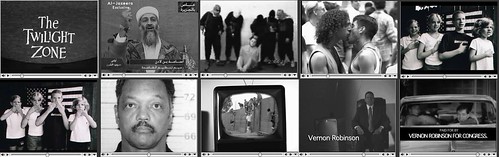
What's amazing about this is it doesn't mention one single issue that will put food on the table for average Americans, but takes time to hit gays, the pledge of allegiance, blacks(using a mugshot of Jesse Jackson), terrorism, and illegal immigrants. After a Twilight Zone presentation of all the evils the GOP sees in the world, it ends with a call to return to the Leave It to Beaver world.


The guy who put this up had to pull it because he got too much flak, but the effort shows a media and pop culture savvy that Democrats could weild even more effectively if they did it with substantive issues instead of having some old fart in a tie talking to an audience or just a camera.

Well worth a watch.


WINDOWS MEDIA: http://movies.crooksandliars.com/twilight.wmv

QUICKTIME: http://movies.crooksandliars.com/twilight.mov


public relations