Showing posts with label los angeles times. Show all posts

Wednesday, December 10, 2008

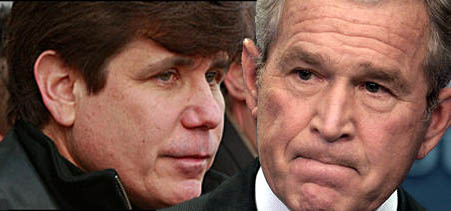
Blago vs. Bush: who abused press more?

Illinois Governor Rob Blagovich, President George W. Bush

The press, federal prosecutors, and even fellow Democrats are rightly outraged at the blatantly corrupt behavior of Illinois governor Rod Blagojevich.

What is odd is how muted that outrage was when similar crimes were committed by the Bush administration.

Consider some of the complaints against Blagojevich:

He wanted the Chicago Tribune to fire their editorial board for being critical of him and used their desire to purchase Wrigley Field as leverage. Bush went a little further in manipulating the press. When Robert Scheer, the most progressive columnist at the Los Angeles Times was fired after 30 years, his publisher told him Bush hated every word he wrote. Since the Los Angeles Times parent company, the Tribune Company had just bought a TV station in a market where they owned the newspapers, which violated anti-trust laws, they needed an FCC waiver from the Bush administration to keep their purchase.

Likewise, Blagovich had several reporters willing to plant news for him to advance his political ends. We know the Bush administration had conservative columnists on the payroll like Armstrong Williams, who they paid hundreds of thousands to promote Bush flawed No Child Left Behind legislation. That violated laws against the government using covert propaganda.

Bush even had an entirely fake reporter (who was actually a male prostitute) planted in the White House press corps to pitch softball questions when Bush didn't like the flak he was catching from the real reporters.

In one respect, Bush entirely outdid Blagovich. He bombed a news organization. Twice.

He bombed the Al Jazeera headquarters in Afghanistan and Iraq, which puzzled Al Jazeera since they had given their coordinates to the US military. Bush wanted to bomb Al Jazeera's main headquarters in Qatar, but Tony Blair had to explain to him that it was bad manners to bomb an ally who was hosting your troops. That wasn't a rumor, it was from leaked minutes of a meeting between the two leaders.

People in the US may not like Al Jazeera because of the criticisms they hear parroted on Fox News and the like, but in reality, they are more like the BBC than Fox's mindless right wing cheerleading--so much so that an American Marine officer who did press briefings for Al Jazeera and other news outlets decided to become a correspondent for the Middle Eastern network.

Congress made noise about some of these offenses, but ultimately did nothing, even after Democrats won the majority in both houses in 2006.

In fairness to those who have done nothing about Bush's crimes, unlike Blagovich, Bush controls who gets wiretapped and who doesn't, and his justice department is unlikely to investigate their boss or appoint special prosecutors to do so. As we have seen with Karl Rove and others, when Congress does issue subpoenas, the Bush administration simply ignores them. Maybe when Bush is out of office, Congress and the new Attorney General will do their jobs.

Maybe Rob Blagovich's offense is not the particular crime but that he did them primarily for himself. When Bush abused the press, although it did benefit his own political fortunes, it was all in service of his political patrons like Ken Lay, big oil, and the sociopathic trust fund babies that run Wall Street. No one goes after Bush because you don't kick the dog of someone you hope will give you a job.

I'll compare some of Blagovich and Bush's other sins next time.


Wednesday, April 25, 2007

LA TIMES email defends token coverage of Cheney impeachment

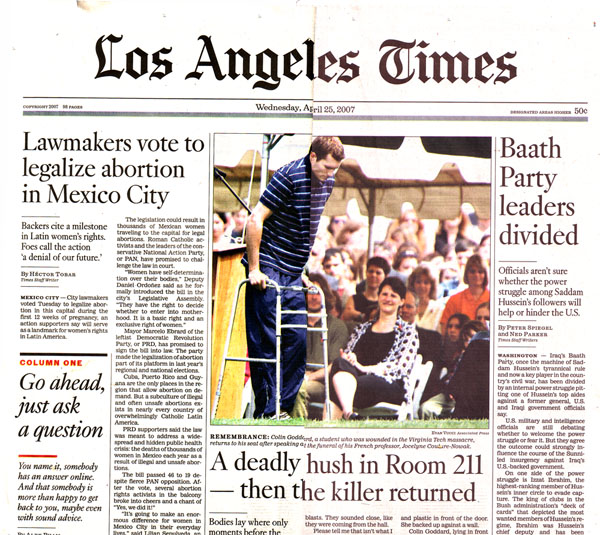
What's missing from today's front page?


Articles of impeachment were filed on Dick Cheney, probably for the first time for a vice president in American history, and the Los Angeles Times could only muster two paragraphs buried on A15, while legalizing abortion in Mexico City merited front page coverage.

Kucinich's impeachment effort is important not just for Cheney's past sins, but for what he and Bush still want to do: bomb Iran. At best, this would lead to Iran unleashing terrorists on us and Israel. At worst, it could spark a nuclear war with China and Russia since they have told us to butt the hell out.

I haven't written these guys in a while, but I had an interesting exchange last time (I even got Greg Palast involved), so I thought it was worth a shot.

My past exchanges:

Arnold & Enron
Response on Arnold & Enron
The editor's mistakes on his own paper's coverage
Editor's mistake on pending Enron lawsuit
Greg Palast weighs in on LA Times, Enron, & Arnold
Same editor on electronic voting
Exchange with head editor on generally vapid content


Here's how it's gone so far this time:


______________________________________________

FROM: Professor Smartass
TO: Leo.Wolinsky@latimes.com, john.montorio@latimes.com, douglas.frantz@latimes.com, melissa.mccoy@latimes.com
(the managing editors and one layer below them)

SUBJECT: Why only token coverage of Cheney Impeachment?

Why did articles of impeachment filed against Dick Cheney by Dennis Kucinich only warrant two briefs paragraphs?

Your headlines above the fold today are on legalized abortion in Mexico City, another story on Virginia Tech that is more personal interest than news, and a power struggle in the Baath Party, who aren't a major player in Iraq anymore. Are those more important than articles of impeachment against Cheney? How many front page stories did you do on impeaching Clinton?

When was the last time a vice president was impeached?

When were such serious charges raised against a vice president or president?

Don't you think this warrants a little more coverage given the tax dollars and lives the actions of the Bush administration has cost us?

______________________________________________

FROM: Leo Wolinsky (managing editor)
TO: Professor Smartass

SUBJECT: RE: Why only token coverage of Cheney Impeachment?

At this point there is no indication that this effort has substantial support. If it does gain momentum we will certainly write a great deal about it. But our job is to determine which stories have the most impact at the time they happen. I do appreciate your views on this and we'll watch the effort closely.

Best,
Leo Wolinsky


______________________________________________

FROM: Professor Smartass
TO: Leo Wolinsky

SUBJECT: Whose support for impeachment of Cheney are you waiting for?

Whose support are you waiting for?

Public support for impeaching Bush is already nearly double what it was for impeaching and removing Clinton at the height of all that hype according to the Wall Street Journal.

Don't regular people like your readers count or do we have to be advertisers or major investors in the Tribune Group?

Article:
http://www.truthout.org/docs_2006/030606N.shtml


______________________________________________

FROM: Leo Wolinsky
TO: Professor Smartass

SUBJECT:
RE: Whose support for impeachment of Cheney are you waiting for?

If the support of the public is there, this will become evident quickly and I can assure you we will cover the story.


______________________________________________


Rather than berate the mainstream media, we should take this as a challenge to get this on their radar. So go to the post office, buy a pack of five postcards, and send one to your congressman with these three words on it:

SUPPORT
CHENEY
IMPEACHMENT


You can find your congressman's address here:
http://www.house.gov/writerep

Remember to put a return address on it, so they know you are a constituent.

Send the other four postcards to the managing editor of your local paper and any TV news you want with these three words:

COVER
CHENEY

IMPEACHMENT


Sunday, May 01, 2005

Arguing with LA Times editor about electronic voting lack of coverage

NOTE: LA Times California Editor David Lauter's comments indented
Professor Smartass's comments aren't.

On Apr 25, 2005, at 10:42 AM, Lauter, David wrote:

Think back to what happened on election day: The exit poll starts gathering data first thing in the morning. Round about midday, preliminary results from the still-incomplete exit poll begin to dribble out onto the internet and rapidly get circulated. Those preliminary results showed Kerry leading and got a lot of people excited. Unfortunately, an incomplete exit poll is like a half-baked cake -- not fit for consumption. That's why the pollsters hate it when incomplete results get circulated -- they are often very misleading. (But in the era of the internet, there's not much you can do about that.) As the evening went on, and the poll was finished, the results began to shift and ended up in the other direction -- showing a Bush victory. By then, tho, no one was paying much attention to exit poll numbers because there were real results to look at. So there's this myth that's grown up that the exit polls showed a Kerry victory. They didn't.

The fact that the numbers shifted during the day was a pain in the neck for our reporters (and their colleagues at the NYT and WashPost) who were assigned to write analytical stories. They started the afternoon thinking they might be analyzing a Democratic win, but then, around 5 p.m. (pacific time), had to shift gears as the numbers shifted. But the fact that the polls were inconvenient to reporters (or briefly misleading to people who got incomplete numbers off the internet) isn't a page-one story.
I am a little over 40, so I can remember part of the evolution of this exit poll business. The policy of withholding results was not to make sure they got the numbers right, but as a courtesy to voters who hadn't gotten to the polls yet. Projection were made with fairly small percentages of precincts reporting that turned out to be remarkably, and maddeningly, accurate hence the need for the courtesy gag.

In this case, the shift in Ohio and a couple of other states came pretty late in the day, and the percentage change didn't jibe with the number of votes added to the result a couple of people bothered to take snapshots of the exit poll data on CNN and this is the basis of the concern that forced the exit polling companies to comment.

The after the fact explanation the exit polling companies felt compelled to give was that Republicans didn't talk to pollsters and voted late. In essence, they adjusted their polls to fit the vote count and came up with the explanation after the fact. If it was a Third World country or the Ukraine, we wouldn't consider it a conspiracy theory to say that something seems fishy.

In addition to the results not fitting the exit polls, they didn't fit the pre-election polls which were closer to a dead heat, Bush's job approval rating which barely hovered at 50% (a couple of points lower than his dad when he was defeated), and the tendency of undecided voters to break for the challenger among other things.

I don't recall ever having said that Republicans wouldn't rig an election. Sure some might if they thought it was necessary and they could get away with it. So might some Democrats. (Read Robert Caro on Lyndon Johnson's first election to the Senate if you want a well documented example). But conspiracies are much harder to put together (and even harder to hold together) than some writers like to believe. (It's not just a lone programmer who must be bought off for all time, it's also everyone the programmer talked to, the secretaries, the person who decided which precinct to fix and by how much, etc.) That's why historically, rigged elections have usually shown up in one-party areas where one side controlled all the levers of power and could be reasonably assured of immunity from investigation. (south Texas in the Johnson days, south Chicago under the late Mayor Daley, etc.) These days, in part because of the internet, there are many fewer such places, so the risk of exposure is much higher. That doesn't mean it can't happen. It does mean that you should exercise a certain healthy skepticism about claims of conspiracy and expect more in the way of proof than assertions about "Democratic Nebraska."

You have latched on to that Democratic Nebraska thing and ignored the more substantive elements of the story. While reporters have an obligation to get facts like that right, different people have different areas of expertise, and the voting machine story is largely the domain of nerdy number crunchers and computer programmers not political color commentators.

The more relevant part of the story is that Hagel owned the voting machine company that counted his votes. That's like the casino owner playing at his own blackjack table, or a lottery official buying a ticket--you'd be a little suspicious if they won.

The New York Times acknowledged in an editorial that these machines are less stringently regulated than video poker machines, which must have their code inspected while voting machine companies withhold theirs as trade secrets.

I don't doubt that Democrats have or would rig elections, and in heavily democratic states like California, that could be a risk, especially in primaries between a more progressive and a more "business friendly" candidate. Right now though, the Republicans control the White House, the Congress, and the courts. And their friends and allies own the voting machine companies. That should make them the story.

They also have a motive to do so: polls show that race baiting and gay bashing don't play as well with young voters, and the Latinos that they bash every other election cycle are a growing percentage of the population. The GOP has money and corporate America behind them, but a potentially shrinking voter base apart from the religious right. It's not hard to imagine them addressing that problem with tools that have been used very effectively in other parts of the world and often with American help.

I would like to think that it's important to have the most honest voting process possible so the results can't be rigged in anyone's favor. I wouldn't be happy if I was voting on one of those old lever machines either, whoever was hiding behind the curtain counting votes..

It is more than just one programmer, and if you googled any of the major players in electronic voting you would find complaints about reliability as well as criminal and civil court cases. Frankly, the story of that programmer is so on the money, it seems too good to be true, so I am a little leery of it. But the analysis of the code by computer scientists at various universities holds a little more weight, as does seeing an elected official try to vote for herself and have the vote recorded for her opponent on not one but several machines in a row on that brief video clip I sent you.

It's hard to feel like I've been debunked when you read two words of the Scoop article, and ignored the other evidence I sent. At the very least, if it turns out to not be credible, you can make fun of Howard Dean for humoring us kooks who would prefer to have recountable votes.
Finally, there are a lot more efficient ways to skew an election than the highly risky one of trying to rig the count after the fact. Consider, for example, what the GOP is doing right now in Georgia, where Gov. Perdue has pushed a bill thru the legislature to require photo IDs for voting -- a step that he can assert is a "good government" move, but which is likely to disenfranchise thousands of impoverished (mostly black, mostly Democratic) rural voters. That's the real Republican tactic, and all the attention to (mostly vaporous) claims about electronic voting largely distracts attention from it.
I look forward to extensive coverage of this ID issue in the Times.

Why would you call rigging voting machines a conspiracy theory but not this ID thing? When I first heard about it, I thought it was a legitimate concern the GOP had. The racial electoral advantage motive has to be inferred even though it's a reasonable inference.

Why do you want to see this as an either/or question? If someone has no compunction about making it difficult to vote by requiring ID, why wouldn't they resort to other methods? In Florida in 2000, there was clear evidence they did as many as possible: purging blacks from the voter rolls by pretending they were felons, harassing blacks on the way to the polls, and stopping vote counts with mobs of congressional staffers.

There seemed to be little risk to doing this either. It was blacked out of the national media though to the LA Times credit, they did do a page one story on the felon voter purge--in May, well after it could have affected the outcome of the contested election and six months after Greg Palast broke the story. Why was that story delayed by the way? If it was page one material that late, wouldn't it have been even more newsworthy when the outcome was still in play? Can you see how that might look like favoritism toward those in power or worse, cowardice?

Likewise, as I mentioned before, the problems with electronic voting machines here in California got buried in the back pages of the Times and emphasized the pissing match between Shelley and the county clerks rather than the substantive issues while the campaign against Shelley got A1 treatment.

That doesn't sound like much of a risk of exposure, and if I passed our debate about this along to the executives of any voting machine companies or Karl Rove, I doubt that they would be losing any sleep.

I will say this though, what you have written in these emails is more interesting and dramatic than the coverage in the Times.


Wednesday, April 20, 2005

HEAD EDITOR OF LA TIMES REPLIES

Mr. Carroll,

Thank you for taking the time to reply.

As I mentioned in an earlier letter I mailed to you, I would like to know why you haven't covered the Bush administration's plan to privatize and sell off, essentially steal, Iraq's oil, and the subsequent revision of that policy.

You guys did a great series recently on corruption in reconstruction contracting, which wastes a lot of tax payer dollars, but this privatization scheme probably contributed directly to the insurgency and was why the Bush administration made no plans to pull out and in fact is constructing over a dozen major military installations there.

This is the very heart of the story in Iraq, and Americans need to hear to decide knowledgeably whether to support what our government is doing in our name.

To the degree that the media fell for and printed uncritically the administration's lies about why they went to war in Iraq, you have an obligation to print the real story.

Professor Smartass


__________________________________________

On Apr 19, 2005, at 4:08 PM, Carroll, John - LA Times wrote:

Thanks for the thoughts. I attended the Murdoch talk in Washington and found it interesting. As for our "info-tainment" strategy, I'm not sure what you're talking about. The front of our paper is packed with serious news from all over the world. Calendar does cover entertainment, but in a sophisticated way -- could you imagine a paper based in Los Angeles not doing so? Regarding our fear of scaring away advertisers: We just lost GM because of a Dan Neil column, which we have no intention of correcting or retracting. And no, we don't care about Rush Limbaugh. I agree with your general sentiments about what a newspaper should do, but I believe the L.A. Times is doing them as well as any paper in the country. Yours truly, John Carroll


[Carroll, John - LA Times]


-----Original Message-----

From: Professor Smartass
Sent: Thursday, April 14, 2005 10:19 AM
To: John.Carroll@latimes.com
Subject: Rupert Murdoch on why newspapers are dying (not why you think)

Rupert Murdoch says 18-34 year olds don't find the news media trustworthy OR entertaining, which means you are not only failing at your reason for existence, providing news, but also at your misguided info-tainment strategy.

Two of the successful British internet news sources he mentions, the BBC and the Guardian, differ markedly from their American counterparts in reporting the news regardless of whose ox is gored in the case of the BBC, and printing opinion pieces that are factual, written by the real players (not think tank PR hacks) and question the essence of the policy of those in power.

Real news and real, reasoned dissent.

I would buy a newspaper for that, and trust that I would hear about what's on Bush's iPod and what kind of bikini wax Arnold Schwarzenegger uses on his nipples on Entertainment Tonight.

I know you guys are in a bind; you don't want to scare away advertisers or get that flood of angry letters from toothless, hillbilly Rush Limbaugh fans and that nasty call from Karl Rove, but timidity makes you bland and bland doesn't sell.

You should make it your goal to get those angry letters and consider them a gauge of your success as long as your story is accurate and serves no interests other than giving the public NEWS they actually need to know for democracy to function.


KEY EXCERPTS:

He said consumers wanted "control over the media, instead of being controlled by it", pointing to the proliferation of website diaries known as "blogs" and message boards.

And newspaper editors simply cannot afford to ignore this, he said, or to look down on readers or ignore what they actually wanted.

He said consumers between the ages of 18-34 were increasingly using the web as their medium of choice for news and neglected more traditional media.

Young people's attitudes towards newspapers were "especially alarming", he said. "Only 9% describe us as trustworthy, a scant 8% find us useful, and only 4% of respondents think we're entertaining."

He described the shift in attitudes as "a revolution in the way young people are accessing news".

"They don't want to rely on the morning paper for their up-to-date information. They don't want to rely on a God-like figure from above to tell them what's important. And to carry the religion analogy a bit further, they certainly don't want news presented as gospel."

Mr Murdoch, who recently held a summit with his newspaper bosses about forging a new internet strategy, said the industry had "sat by and watched" as circulations had fallen over the past 40 years, complacent because of its historic monopoly on the news business.

A rise in population had masked a relative decline in the TV age, he said, while in the 1990s profitability had held up in spite of circulations falling, further lulling the industry into a false sense of security.

"But those days are gone," he warned. "The trends are against us...so unless we awaken to these changes, which are quite different to those of five or six years ago, we will, as an industry, be relegated to the status of also-rans."

Now, however, the Sun is, along with the Guardian and the BBC, one of the top 10 news websites in the UK but the online operations of the Times and Telegraph, which have not received the same investment, are not ranked in the top tier.

FULL TEXT:

http://media.guardian.co.uk/site/story/0,14173,1459697,00.html


Tuesday, March 29, 2005

BBC's Greg Palast gives me a message for LA Times editor on Arnold/Enron news blackout

On Mar 19, 2005, at 10:57 PM Professor Smartass wrote:

Greg,

I recently wrote a letter to the LA Times asking why they haven't been more aggressive in covering Arnold's relationship to Enron and the other energy scammers, and attached the project censored coverage of your story. The editor disputed some of the basic facts about Cruz Bustamante even filing a lawsuit, and Arnold having the ability to make it go away.

You can see the LA Times letter and my original letter at http://professorsmartass.blogspot.com/

-- Professor Smartass


______________________________________


From: contact@gregpalast.com

Subject: Re: LA Times disputes Arnold/Enron story
Date: March 29, 2005 12:54:51 PM PST

Hi Professor Smartass,
Greg has written a response which he would you to post or sent to this LA Times guy.
Thanks for making us aware of it.
Kindest regards,
LENI

Here's Greg's comment:


The LA Times editor misreads my exposé on your governor's undermining of the legal action against Enron and other power pirates (or, typical of editors, he commented without reading it).

I'm not surprised. This is a highly complex matter involving regulatory financial accounting and the nexus of regulatory and tort law. It is not the expertise one normally finds in a typical newsroom where almost all matter printed comes from simplified press releases and official statements.

While best known for my TV and popular writings, I am, in another life, an expert on electricity finances and law, author of a seminal work in the area, Democracy and Regulation, introduced by California Public Utilities Commissioner Carl Wood, based on my lectures at the Department of Applied Economics at Cambridge University, England, and the University of Sao Paolo.

The Times editor says his reporters have reviewed much energy-related "stuff" -- and could not find these stories. Indeed, the Times missed the entire Enron story until they could re-print the discoveries of the Wall Street Journal.

I sympathize with the Times limitations in this area; which is why it may be unfair that my team won a journalism award for this story from California State University and not the Times.

As one newspaper wrote in an embarrassingly glowing profile of my reporting, "Palast's ability to make sense of stacks of dense financial data earned him a reputation for doggedness (he holds an MBA from the University of Chicago)."

It was in the LA Times.

Greg Palast
Author, "The Best Democracy Money Can Buy." View Palast's reports for BBC TV at www.GregPalast.com


Wednesday, March 23, 2005

final rounds of Arnold/Enron debate with LA Times editor

David.Lauter@latimes.com
RE: Your defense of Arnold/Enron coverage
Date: March 21, 2005 3:14:50 PM PST

Re Bustamante's suit: He sued as an individual, not on behalf of the state, so there's not much that Schwarzenegger could do to settle the case, whether he wants to or not. (There also may not be much to come of the suit since it's not on behalf of the state.) Lockyer has a number of proceedings in which he's been pursuing the energy companies and has actually gotten some large settlements. No one's likely to get much money out of Enron since it's bankrupt.

Re the broader issue: You can only connect the dots, as you put it, if there's actual evidence. We've had a number of reporters scrub through all sorts of energy-related stuff several times, and we've published what we thought was provable.


_____________________________________________

Professor Smartass
Re: Your defense of Arnold/Enron coverage
Date: March 21, 2005 5:12:16 PM PST

Enron was just one of the named defendants in the suit. I talked to Bustamante's office today, and they said the suits are still in play. It sounds like you aren't too familiar with them, so I'm attaching the original complaints.

Enron was just one of the named defendants in the suit. I talked to Bustamante's office today, and they said the suits are still in play. It sounds like you aren't too familiar with them, so I'm attaching the original complaints.

_____________________________________________

David.Lauter@latimes.com
RE: Your defense of Arnold/Enron coverage
Date: March 21, 2005 5:39:04 PM PST

Thanks. I am familiar with the suits.


Monday, March 21, 2005

Arguing with LA Times editor about Arnold/Enron story


March 21, 2005

David Lauter
Deputy Editor/Daily
Los Angeles Times
202 W. 1st St.
Los Angeles, CA 90012

Dear Mr. Lauter,

Thank you for your quick response.

Since you are a professional journalist, I would expect you would know more about this stuff than I would.


But I was unclear on a couple of things from your response. By saying that it is the attorney general’s prerogative to file lawsuits on behalf of the state, does that mean that there is no suit filed by Cruz Bustamante on behalf of utility customers, as covered by the LA Times on page A21, May 3, 2001? To your credit, you did cover that story, but it was buried on page A21, even though the blackouts were front page news for those of us affected by it. I was giving a college final when a blackout occurred and had to decide between canceling it or having my students huddle under one dim emergency light to finish their essays.

You said you covered this issue prominently, but a search of the archives for Schwarzenegger and Ken Lay or Kenneth Lay turned up a handful of incidental mentions in campaign notebook articles, usually when another candidate or protestor mentioned it, and to their credit, in the columns of Steve Lopez and Patt Morrison.

Further, your Jun 30, 2004 story on page C1 seems to confirm what Greg Palast of the BBC reported the summer before: that Arnold would support the weaker FERC settlement rather than the civil suit filed by Bustamante. The article could have connected the dots to explain why a governor so fixated on slashing our budget wouldn’t be interested in recouping as much as possibly of money stolen from us.

To the Times credit, you have covered Arnold’s push to further deregulate electricity, but again, this was buried in the California section of the paper even though the consequences, further rate hikes and blackouts, would be front page news to most Californians. A scan of recent Arnold front page stories includes his visit to the La Conchita landslide, his proposal for a low budget bridge in San Francisco, and his proposals regarding Indian gaming. Are these stories really more important than our governor trying to help the criminals who screwed us out of billions of dollars and who turned out our lights?

You are right that the meeting with Ken Lay by itself might not mean much, but Arnold got substantial aid from President Bush, not the least of which was advice from Karl Rove, staff loaned from Jeb Bush, and a visit from the President to Gray Davis to say he WOULD NOT intervene to cap electricity prices. At the time, Ken Lay was still the lifetime top donor to George W. Bush (he may still be). It’s not exactly a conspiracy theory to connect dots that big, and if the press was taking it’s watchdog function seriously, Arnold should have at least had to give a good explanation why all those things lined up in his favor without this being racketeering before the election.

You did this kind of work on Arnold’s sexual harassment problems. You didn’t just mention a case as it came up, but did the research to connect the dots. That’s all I’m asking. Connect the dots on the front page of the LA Times far enough before Arnold runs for re-election that information becomes part of the public debate.

Given that television news has become a embarrassment focused on celebrities and murder cases, and the free ride Arnold gets on right wing talk radio, where he is fawned over and unlikely to get a tough question, you have an even greater obligation to give the voters of California the news they need to make an informed decision because they aren’t getting it from any other local media.